Research
State of play: US spa numbers
Spa revenue is at an all-time high in the US for the second year running, but does this momentum have a threshold? Megan Whitby digs into the findings of two fresh ISPA studies




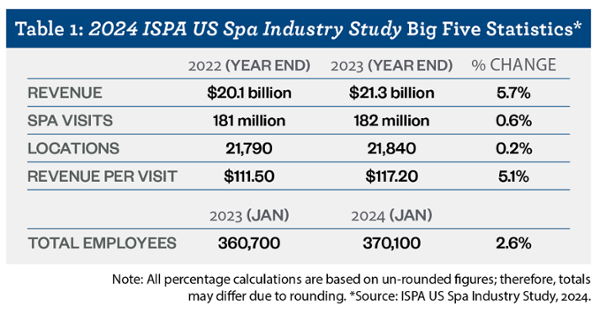
The US spa industry reached US$21.3 billion (€19.9 billion, £17 billion) in revenues in 2023, surpassing the previous industry high of US$20.1 billion (€18.7 billion, £16 billion) in 2022, according to a sneak peek of the Big Five statistics from the International Spa Association (ISPA).
The other core metrics from the 2024 ISPA Spa Industry Study, based on 2,400 operators and conducted in partnership with PricewaterhouseCoopers (PWC), were positive too, yet some KPIs experienced stronger growth than others (see Table 1).
Average revenue per visit in 2023 climbed more than 5 per cent from US$111.5 (€104, £89) to US$117.2 (€109, £93) and the total number of employees now sits at 370,100, a 2.6 per cent rise since 2022. Less uptick was observed in the number of spa visits which equalled 182 million (+0.6 per cent) and the number of locations that came in at 21,840 (+0.2 per cent).
So what meaning can we attribute to these benchmarks? Spa Business takes a closer look at the figures and also delves into the 2024 edition of ISPA’s Consumer Snapshot survey to gain more insights.
Is growth slowing?
Every year, ISPA reveals its Big Five statistics ahead of its full research in July/August and first teased its 2024 findings with delegates at the ISPA Conference in Arizona, USA this April.
ISPA president Lynne McNees says overall these latest numbers give out a positive message. “Revenue drives growth for spas,” she says. “Increasing overall revenue and dollars spent per visit allows spas to hire more employees and open new locations. This year’s good news will enable the spa community to reinvest in growth.”
Colin Mcilheneny, ISPA research advisor – who presented the Big Five on stage – however, flags that the metrics required further attention.
He notes that with overall revenues steadily climbing while visitor numbers remain stagnant, the driving force behind this growth lies with consumers who are investing more per visit to spas. “In light of the current cost of living crisis, it’s crucial to ask: Are these upward trends sustainable,” he says. While a portion of the revenue increase can be attributed to adjusted pricing structures, it’s essential to recognise that customers may have reached their spending thresholds, he adds.
Best customers
Released in March, the 2024 edition of ISPA’s Consumer Snapshot survey suggests that customers who visit spas more frequently could be the key to future success.
The survey was based on the responses of 1,002 spa-goers in December 2023. ISPA defines a spa-goer as someone who’s been to a spa in the last 12 months and found that 70 per cent of survey participants had visited at least twice in the previous year – making them a ‘regular spa-goer’. Subsequently, it found that these regular spa-goers will likely spend the most – US$200 (€186, £159) and over – in a year.
“Regular spa-goers are significantly more likely to spend more money while in the spa on treatments and spend money on other wellness-related facilities, such as gyms and beauty salons,” according to the report.
“They’re also more inclined to adopt healthy lifestyles and see going to the spa as a long-term commitment to their health and wellbeing. They have higher incomes than irregular spa-goers which gives them more flexibility to spend their money on discretionary activities and add them into their regular routines.”
Enticing regulars
A further breakdown of regular spa-goers shows that 45 per cent of them are millennials (aged 27-42), mostly employed (82 per cent) and that 58 per cent have a household income between US$50,000-US$149,000 (€46,613-€138,906, £39,882-£118,848).
To encourage more regular customers, spa operators might want to consider introducing membership packages as the rise in popularity of Netflix and Amazon has opened consumer mindsets to subscriptions. And on p110 Spa Business investigates how software suppliers can help operators with membership set-up and management.
Almost all spa-goers (96 per cent) have purchased some form of annual subscription/membership that has year-round access/benefits (see Graph 1). Specifically, 31 per cent are already members of spas and 41 per cent have signed up to gyms. Furthermore, 67 per cent of participants agreed with the statement ‘Spa memberships that extend a set number of treatments per month are of great interest to me’.
However, across all spa-goers, there was a sentiment that spas are expensive and that having deals or offers could entice them to visit more frequently.
Mental health focus
A shift in perspective emerged among frequent spa attendees, who increasingly view treatments as indispensable investments in stress reduction and mental wellbeing. While spas were once regarded as luxuries, today’s patrons prioritise their visits not only for indulgence but for mental health and overall wellness, the survey shows.
In fact, even though indulgence came out as the key motivator behind spa visits, reducing stress and taking a step towards leading a healthier lifestyle were significant contributing factors.
Around 80 per cent of respondents agree that looking after mental wellbeing and eating healthily is an important part of the daily routine. Moreover, 96 per cent of spa-goers state they’ve taken steps to look after their mental wellbeing in the past 12 months with sleep and health being the key focus.
In the aftermath of a global pandemic, it’s interesting to note how spa consumer behaviours, habits, attitudes and expectations are changing. And the two ISPA studies not only illustrate the current state of play in the US industry but also highlight where the opportunities lie for the future.

“Increasing overall revenue and dollars spent per visit allows spas to hire more employees and open new locations. This year’s good news will enable the spa community to reinvest in growth.” – Lynne McNees, ISPA president

“In light of the current cost of living crisis, it’s crucial to ask: Are these upward trends sustainable?” – Colin Mcilheneny, ISPA research advisor