Insight
Global fitness report
Research firm Qualtrics surveyed 12,157 consumers across 15 countries in seven languages to create the Les Mills 2021 Global Fitness Report, highlighting the ways consumers are choosing to work out as we emerge from the pandemic. Jak Phillips reports




The Les Mills 2021 Global Fitness Report explores how the pandemic has changed fitness habits and spotlights the trends that will shape workouts in the years to come.
The study reached consumers in the USA, Brazil, the UK, Germany, Norway, Sweden, Finland, Denmark, Saudi Arabia, the UAE, China, Japan, Russia, Australia and India.
It found gyms around the world are experiencing a ‘live revival’, with fitness fans eager to get back to working out with friends for motivation and social connection after months of solitary home workouts.
As well as the return of live workouts, the report explores how digital offerings are likely to evolve beyond the pandemic and what strategies fitness operators can deploy to provide the optimal mix between live and digital offerings to meet the increasingly sophisticated needs of members.
“As the fitness industry continues its rapid expansion, the margin between success and failure becomes ever finer,” notes Les Mills founder and executive director, Phillip Mills, in the report’s foreword.
“Against a backdrop of fierce competition and fast-changing trends, razor-sharp insight and excellent execution are the keys to stealing a march on your rivals.”
Below is a snapshot of seven key trends highlighted by the report.
More: www.HCMmag.com/LMGFR
COVID-19 has forced all businesses to re-think their go-to-market strategies. For fitness providers, this has meant using the pandemic as a catalyst for a completely new approach to meeting people’s fitness needs.
The pandemic has prompted consumers to prioritise their health, with 50 per cent of the sample focusing more on their wellbeing in 2021 than previously, while 82 per cent regularly exercise (or soon plan to).
Of those who exercise, 75 per cent do gym-related activities, making fitness the world’s biggest sport. This presents growth opportunities for fitness providers as COVID-19 restrictions are lifted and their clubs return to full capacity.
The report finds clubs worldwide making strong recoveries since reopening and in markets where restrictions have lifted, operators are reporting increased member activity compared to pre-COVID levels, and decisive eagerness among new joiners.
Major players such as David Lloyd Leisure in the UK (see www.HCMmag.com/RussellBarnes) have already surpassed pre-COVID membership levels, while Planet Fitness, Pure Gym, and The Gym Group have all released strong earnings reports in recent weeks, demonstrating resurgence among club operators in some world regions.
Despite fears the COVID-inspired home fitness boom would spell the end for fitness facilities, research suggests social live fitness experiences are driving the club recovery, with 85 per cent of gymgoers stating they’re interested in trying live classes in their health club. Meanwhile, class occupancy has reached 120 per cent of pre-COVID levels in markets where capacity restrictions have been lifted.
After a year of enforced home workouts, appetite for live fitness experiences in groups is soaring. Two-thirds of gym members (67 per cent) say they prefer working out in groups, while live classes in club are nearly twice as popular as doing livestream classes at home (favoured by 44 per cent of members vs 23 per cent).
“After months of being stuck at home, people can’t wait to get back to fitness facilities and enjoy their favourite workouts with familiar faces,” says Phillip Mills, Les Mills founder and executive director. “Much like bars, restaurants and sports events, fitness is experiencing a real ‘live revival’, as people make up for lost time with a renewed appreciation for real-world social settings.
“Many people have missed the thrill of a busy class and the extra motivation you get from working out with others while being led by a rockstar instructor.”
With strong consumer demand for social connection driving the live revival, it’s inevitable the people working in clubs will have a vital role to play.
Great instructors are identified as the single most important factor for gym-goers when choosing a live class, favoured by 28 per cent, ahead of the quality of music (24 per cent) and type of class (21 per cent).
Quality instructors are cited as a key component of the live revival, meeting strong consumer demand for added motivation and deeper connection in their workouts.
Having great people is particularly important for winning new members – 30 per cent of club prospects say “a good atmosphere” is a key factor in choosing a gym to join, while 59 per cent say staff are also a consideration.
“Despite the digital advances made during the pandemic, it’s our people who drove members to join clubs in the first place, and as you’ll see in this report, it’s our people who are proving the key to bringing them back,” says Phillip Mills.
What’s the perfect blend of live and digital workouts in the new age of fitness? It’s a question taxing many club operators and one which the report sets out to answer through the latest data and examples of success from various markets.
Omnichannel fitness – a blend of in-gym and digital home workouts – is tipped to gain traction as we emerge from the pandemic, with the majority of exercisers (59 per cent) favouring a 60:40 split between gym and home workouts. Far from being simple stop-gaps to tide the industry over during the COVID pandemic, livestream and on-demand have become vital additions to clubs’ long-term digital offerings, with 80 per cent of members planning to continue using them post-pandemic.
And though live fitness experiences remain the pinnacle, the digital fitness boom and the growth of home working mean today’s fitness consumers demand a connected fitness experience that offers convenience and enables them to maintain a more active lifestyle.
Seamlessly linking live and digital will be key to club success. High-class digital offerings can help clubs win new fans online, build brand affinity, and then eventually convert them to becoming full members of the club.
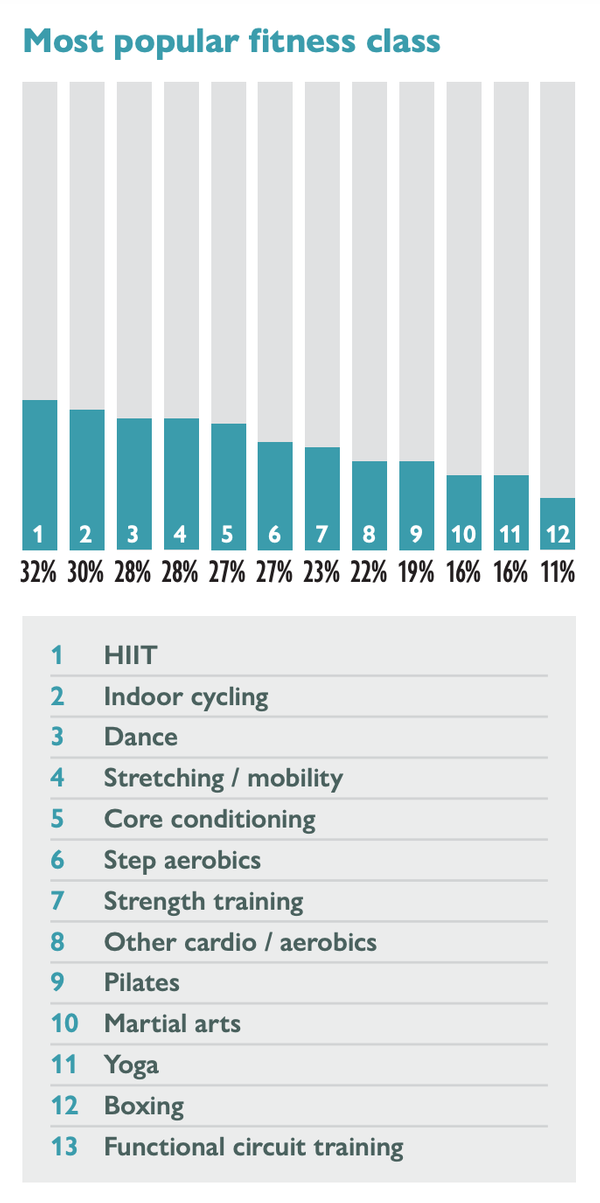
In an industry as notoriously trend-driven as fitness, HIIT is proving the exception to rule. Having dominated most of the last decade, HIIT is hotter than ever, with 32 per cent of consumers listing it as their favourite class format.
But it’s not just HIIT-heads who are loyal – 58 per cent of members say they would likely cancel their membership if their gym took away their favourite class, regardless of the genre.
Participants are also highly discerning, with 86 per cent choosing to do branded classes, and 62 per cent stating the presence of quality elements (the quality of music, instructors, equipment, choreography) are key to deciding which classes they attend.
In a world of endless quantity, it’s never been more vital to focus on quality, particularly from a digital perspective. With Youtube chock-full of free, average fitness content, clubs need to ensure they’re providing world-class content to keep members engaged and willing to pay.
Lockdown saw a new segment of fans who have taken tentative first steps into health and fitness and are now deciding what comes next, with 27 per cent of regular exercisers describing themselves as ‘absolute beginners’.But who are these new market entrants? And what do they want from a fitness experience?
Opportunities abound for the health and fitness operators who can appeal to these groups and understand the unique barriers to exercise they face. Although 81 per cent of beginners are interested in group activities, 66 per cent say they currently prefer to exercise alone, suggesting a confidence chasm that needs to be bridged before beginners feel fully comfortable.
Instructors and wider staff have a key role to play in ensuring they feel welcome, while helping beginners find intrinsic motivation to exercise will be key to their long-term adherence.
As home working becomes more prevalent and the boundaries between work and play are blurred, so too are the distinctions around the provision of fitness services, creating significant opportunities for clubs.
Employers are increasingly recognising the benefits of an active workforce and their responsibility to support this, while employees are gravitating towards companies that care, so the offer of quality fitness services is becoming a key differentiator.
The impact that wellness offerings can have on both work performance and employee health is also accelerating their prevalence, creating lucrative opportunities for omnichannel fitness providers to reach lucrative new audiences.
For clubs, the ability to demonstrate the scientifically proven impact of workouts will place you in a strong position to succeed in the workplace wellness market, where return on investment (ROI) carries great weight among decision-makers.
• 84% of gym members also work out at home
• Gym members are more than twice as likely to use at-home fitness options when compared to non-gym goers
• 86% of group fitness participants are doing a branded class
• On average, 27% of fitness consumers consider themselves absolute beginners. This ranges from 69% in Japan to 14% in the Middle East
• 67% of beginners say they prefer to work out alone
• 35% of the sample exercise to reduce stress
• 59% of those who have access to fitness and wellness services through their employer make use of them
• 59% of people surveyed favour a split of 60:40 between gym and at-home workouts















Designed to restore neglected land and renew the identity of Iraq’s capital city, Baghdad Sustainable Forests promises a new way of living surrounded by nature. Gensler’s Ian Mulcahay tells us why he thinks the project could become a model for the repair and enhancement of urban centres