Industry insights
Best of Both Worlds
One of the fastest-growing trends in the wellness industry today is the merger of medical and wellness services. Ines Hunziker and Ingo Schweder outline what’s involved in creating a successful integrative wellness destination




The coronavirus pandemic, which has affected every aspect of people’s lives worldwide, has fast-tracked interest in the already burgeoning health and wellness industry. Stricken by the social and economic damage that the pandemic has caused, accompanied by increased awareness of personal health and wellbeing, both healthcare and preventative wellness offerings have been pushed to the forefront of peoples’ minds.
Today, the concept of wellness and medical tourism are, at times, becoming increasingly interwoven. Wellness resorts, which are traditionally known for their holistic programming, are increasingly incorporating diagnostics and advanced results-driven treatments, while medically-focused destinations are seeking to broaden their offering to include more wellness services.
This is particularly evident within integrative wellness destinations where the established concept offers both medical and holistic treatment modalities. This article sets out to clarify the primary differences between medical and wellness tourism, to discuss key service platform characteristics of integrative wellness destinations that incorporate treatments and services from both industries, and to provide best practices and considerations aimed at successfully operating such establishments.
Medical vs wellness tourism
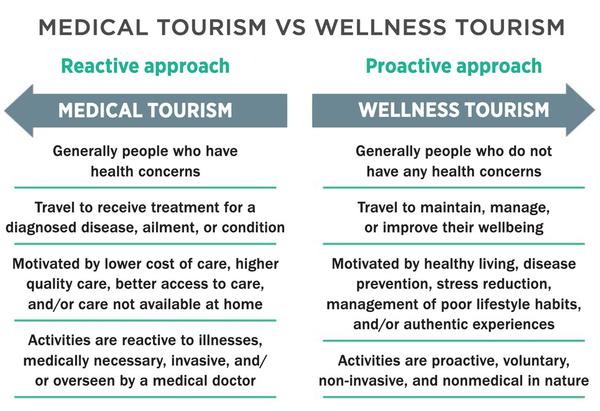
As defined by the Organization for Economic Co-operation and Development (“OECD”), medical tourism is often associated with “travel across international borders with the intention of receiving some form of medical treatment.” Medical tourism is driven by various factors, including the needs of an ageing population, increasingly unaffordable healthcare costs, the availability of cost-effective and quality treatments in emerging nations, and wider availability of advanced medical technologies throughout the world.
Wellness tourism refers to “travel associated with the pursuit of maintaining or enhancing one’s personal wellbeing”, and focuses on promoting engagement in wellness activities that lead to a state of improved holistic health. Unlike medical tourism, wellness tourism is driven by an increased prevalence of non-communicable diseases, work-related stress, poor lifestyle choices, rising mental health concerns and the negative effects of environmental degradation, such as air pollution and climate change.
Over recent years, both the medical and wellness tourism industries have witnessed rapid growth. As of 2019, the size of the global medical tourism industry was estimated at US$65bn to US$88bn, with up to 24 million people traveling for healthcare services annually. The global medical tourism market is forecast to record double-digit growth in the coming years, reaching over US$200bn in value by 2023.
Integrative Wellness Destinations
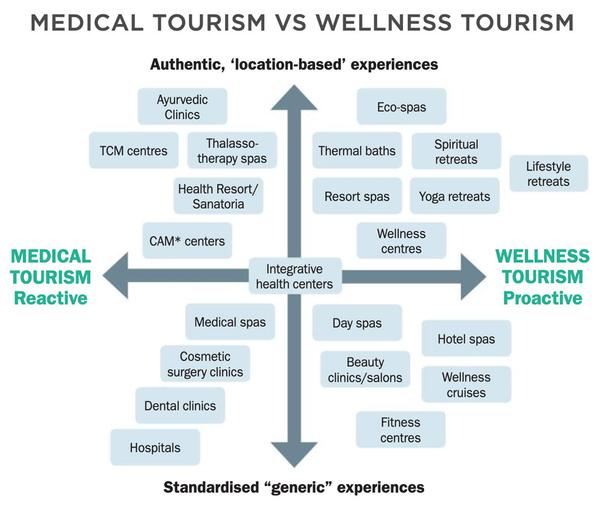
As noted by the Global Wellness Institute, at times, the catch-all term “health tourism” is used to describe both medical and wellness tourism modalities, from surgery to yoga retreats. In fact, although often interrelated, medical tourism and wellness tourism are fundamentally different, as they target various types of travelers with different needs.
However, some resorts combine the two; for instance, in integrated wellness developments such as health resorts, sanatoriums or medical spas that feature a service platform that is both preventative and curative. Integrative resorts usually have a more comprehensive service platform and a broader treatment offering than traditional wellness resorts, including check-ups, diagnostics, consultations, alternative healing, hydrotherapy, and many others.
Integrative wellness destinations generally have a basic wellness offering comprised of massages, body treatments and facials, hydrothermal experiences, nutrition and healthy meals, fitness and mind and body, and wellness programming, as well as extra dimensions that include activities and educational components.
These extra dimensions go a step further by including a number of medically-oriented services such as:
■ Check-ups and diagnostics
Assessment of the guest’s current state of physical and psychological health is the first step on their journey to healing, given that it allows the medical team to formulate an appropriate programme, and therefore represents a key pillar at integrative wellness destinations.
■ Medical, specialised therapies and biohacking
Given their inclusion of medical services, integrative wellness destinations commonly offer a plethora of specialised therapies, combining both Eastern and Western healing modalities such as cryotherapy, colonic hydrotherapy, physical therapy, osteopathy and kinesiology.
■ Rehabilitation
In these instances, guests who visit an integrative wellness destination may have just undergone surgery and need assistance in getting back into physical shape. These guests require the destination to be modelled slightly differently to others, including round-the-clock medical assistance, which may be required in the event of an emergency.
■ Aesthetics and dermatology
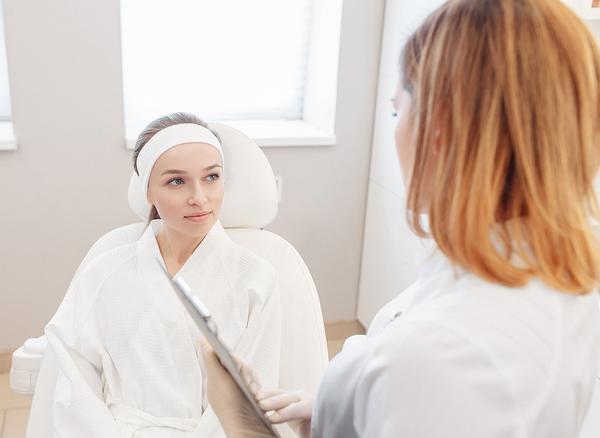
To capitalise on the higher demand for quick fixes, integrative wellness destinations are increasingly incorporating a selection of aesthetic and dermatological services, such as ultrasound, radiofrequency, laser treatments, body contouring, cosmeceutical treatments, injections, and fillers.
A fine line
The line becomes clearer when a property marketing itself as a medical destination curates more of a hospital-like atmosphere and experience instead of a relaxing stay within a hotel or resort. A hospital-like atmosphere is usually created once the property includes invasive surgery (ie, rhinoplasty) as part of its service platform, which requires a surgical team and associated facilities. On the other hand, an integrative wellness destination does not necessarily require a comprehensive medical or surgical team, and communicates a very different guest environment, which is more relaxed and comforting, suited to the needs of its target audience.
A prime example of the preventative approach is found at Waldhotel Bürgenstock in Switzerland, which offers minimally invasive medical services while also providing the option of more extensive treatments, such as wisdom tooth removal, conducted on-site through a local partnership. Thus, the atmosphere conveyed to its guests is not one of recovering patients, but rather of one where guests are focused on prevention and improvement.
An example of a medical destination that is respected for its wellness programmes is Clinique La Prairie, a globally renowned medical clinic and wellness destination. Indeed, Clinique La Prairie is a leading light in preventative medicine, combining bespoke lifestyle and nutrition plans with pioneering medical treatments. Its flagship Revitalisation programme is tailored to clientele’s unique requirements to promote vitality, enhance the immune system, and slow down the ageing process.
Repositioning
For resorts to reposition themselves as a successful integrated wellness destination, certain key elements need to be considered. These include hiring a team of experts and professionals, creating a different organisational structure, implementing equipment usage protocols, establishing local hospital partnerships, and adopting a specific marketing strategy.
■ Hiring of Experts
In order to offer medical therapies within a resort environment, it is fundamental that the property acquires the relevant licensing and hires recognised medical professionals with the approved qualifications to support the legal requirements. Omitting this part of the process may lead to strict limitations on the range of medical services that can be provided. Additionally, it is important to understand to what extent the medical services offered form a core part of the property’s positioning and concept. Indeed, if international expansion is envisioned, the standard medical offering of the property in one country may not be permitted in another due to licensing restrictions. Furthermore, the property must ensure the hiring of a team that delivers a high level of professionalism and creates an environment of safety and trust for guests that come to undergo medical procedures.
■ Organisational Structure
If medical therapies are to be integrated within a resort, it’s essential to have both medical and wellness-focused operational teams working together, each having clearly defined roles and responsibilities.
In order to provide a seamless guest flow within the property, the organisational structure must differ in comparison to a typical wellness resort. Ideally, the wellness operational team works under a director of wellness who manages all of the therapists and line staff, while running the day-to-day operation and administration of the department. On the medical side, a senior medical doctor is in charge of all medical treatments and other doctors. Both the director of wellness and senior medical doctor report to a managing director or CEO who verifies that the teams are cohesive and deliver exceptional service and a seamless guest journey.
■ Specialised Equipment Management
It is important to understand whether the use of specialised medical equipment requires the expertise of a registered nurse or a trained doctor. Some of these services may be classified as advanced services and, therefore, may only be administered by a licensed professional. However, training therapists to deliver such procedures would result in payroll efficiencies, as higher paid specialists can be allocated to other services.
■ Local Hospital Partnership
If the property does not have the resources to provide on-site medical services or wishes to position itself with a more holistic offering, it is recommended that a partnership with nearby healthcare establishments be explored in order to outsource medical services (ie, X-ray scans, bloodwork, etc). Establishing a partnership with a local hospital would allow the property to provide a wider range of services without the fixed costs.
■ Marketing Considerations
A property offering a broad service platform that includes both medical and wellness services will attract customer segments with different expectations. It’s recommended that an integrative wellness destination have different sales and marketing teams dedicated to each group, which facilitates the clear and defined promotion of group-specific offerings.
Future outlook
One of the fastest-growing trends in the wellness industry today is the merger of medical and wellness services within wellness resorts. In line with this growth trend, a greater number of spas and resorts have started providing diagnostics and specialised therapies as part of their health and wellness offering.
While the wellness tourism economy has slowed down due to the global pandemic, it is expected to pick up with increased positive momentum as many individuals seek to boost their immune systems, undergo check-ups and diagnostics, and learn how to live a healthier life. Given that most integrative wellness resorts attract a more affluent guest, the pandemic may encourage a shift, opening up a market for more democratic access to treatments and more mid-range integrative wellness resorts that target a broader customer segment.
Ines Hunziker is a senior analyst at Horwath HTL Thailand Health & Wellness. [email protected] Ingo Schweder is managing director at Horwath HTL Health & Wellness. [email protected]
You can read the full white paper at Horwath HTL’s website. www.horwathhtl.com

















Designed to restore neglected land and renew the identity of Iraq’s capital city, Baghdad Sustainable Forests promises a new way of living surrounded by nature. Gensler’s Ian Mulcahay tells us why he thinks the project could become a model for the repair and enhancement of urban centres