Green Developments
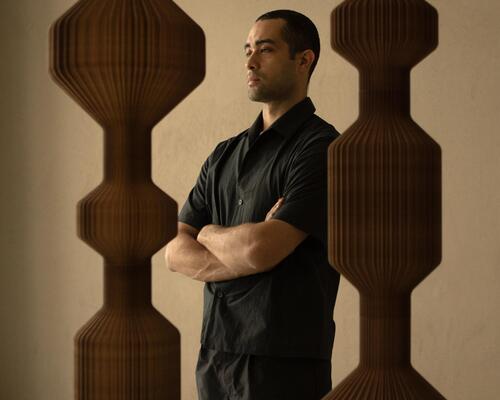
Richard Hassell, WOHA
GREEN IT UP - Leaders in sustainable design tell us how buildings can bring wellbeing to people, even in high-density cities




Stress, heat, pollutants, artificial light, sedentary lifestyles … it’s little wonder the planet’s city dwellers are seeking respite when they travel. Whether drawn to the prospect of reconnecting with nature or investing in time to enhance their sense of wellbeing, more people today are electing to holiday in destinations with a wellness offering. Just as Asia has proven a pioneer of the spa resort, so too has the region been leading a movement to reverse the decline in quality of our built environments. Populations may explode, metropolises may sprawl, high-rises may climb ever higher but perhaps our urban spaces need not be the natural enemy of wellbeing. That’s certainly the thinking behind the green strategies being developed by progressive design studios in Asia and America. They believe it’s possible to create a sense of wellbeing both for people and the planet through a commitment to sustainable building design in urban settings and beyond.
Holistic approach
“It’s been well documented that being connected to nature has positive psychological and physiological benefits,” says Richard Hassell, director of award-winning WOHA Architects.
“Greenery is wonderfully effective at combating the heat islands created by cities, while removing polluting volatile organic compounds such as benzene and formaldehyde from the air,” Hassell says. “So when we build an urban hotel or residence, we think of it from the outset as a resort in the middle of the city. We believe it’s essential to maintain the ratio between building density and space allocated to naturally calming environments. Indeed by working to a minimum ratio of 100 per cent, whereby the world is just as green as it was prior to our site being developed, we apply what we call our ‘do no harm’ quantum.”
Based in Singapore, WOHA set benchmarks over 10 years ago with its design for Newton Suites, a 36-storey residential development in which an area of landscaping equivalent to 130 per cent of the site was generated. The high-rise was partly responsible for Singapore’s planning authorities moving towards the 2009 implementation of its Landscaping for Urban Spaces and Highrises (LUSH) programme, applicable to private developments in the residential, hospitality, retail and office sectors. Covering designated ‘strategic areas’ of the city, one of the programme’s core stipulations is that private developers must replace greenery lost as a result of their project’s construction with landscaped areas equivalent, at least, to the development’s site area. This replacement greenery can be provided in the form of landscaping, roof gardens, sky terraces or planter boxes, and should incorporate communal facilities. Developers of existing mixed-used properties meanwhile are rewarded with bonus gross floor area for outdoor dining facilities if they make an application to convert their rooftops into a garden or green space.
Parkroyal on Pickering
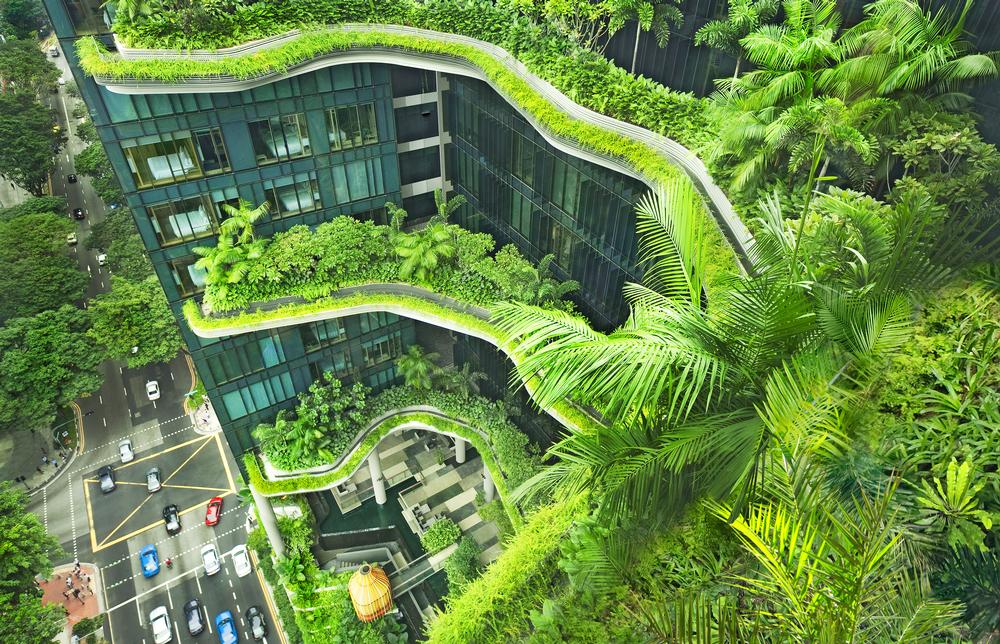
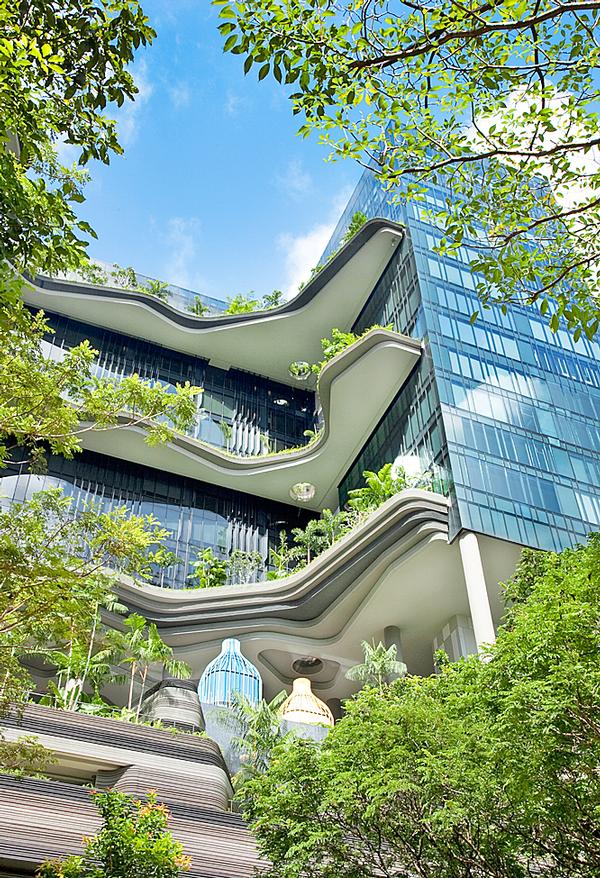
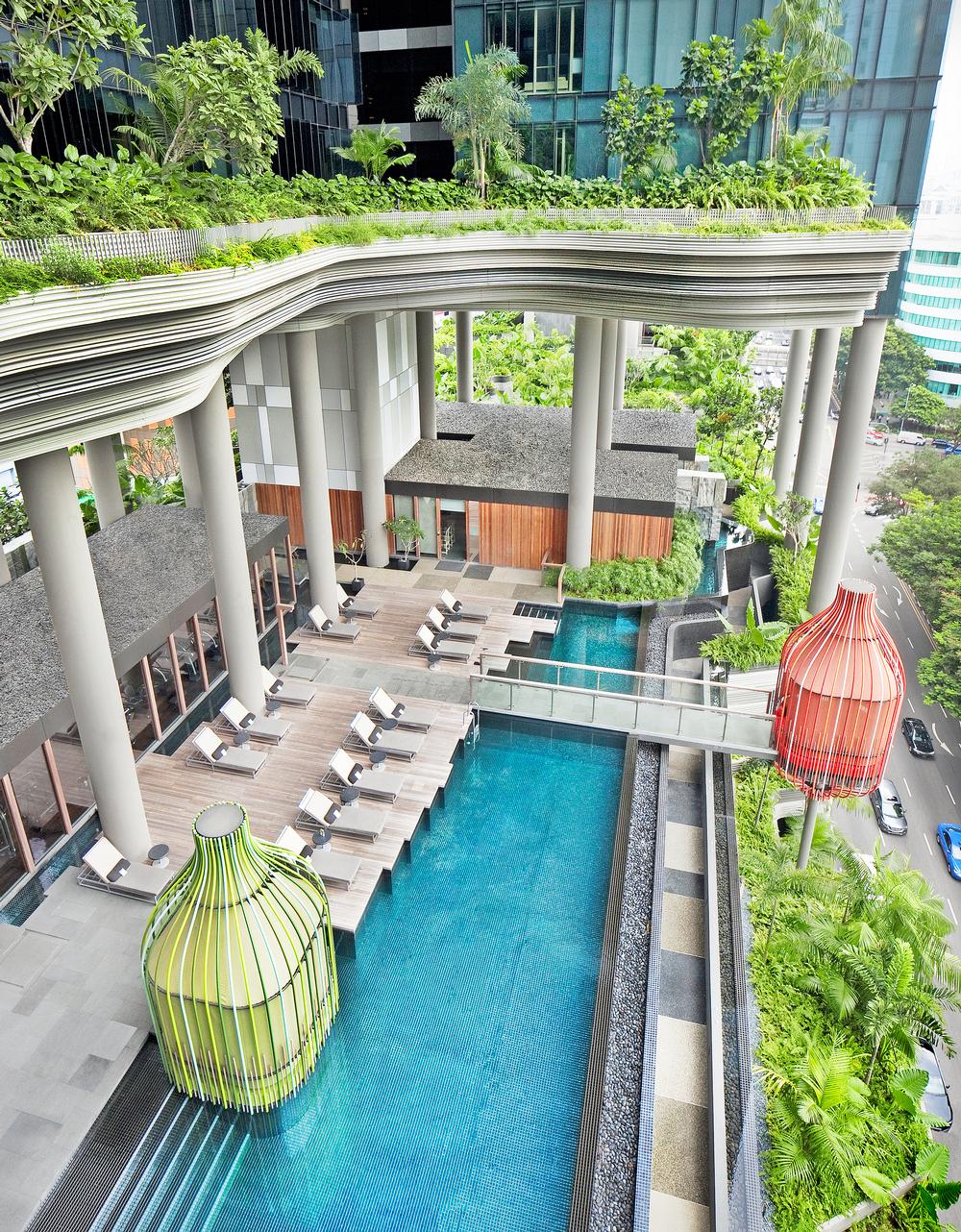
Applying learning from the residential to the hospitality field, WOHA has since been responsible for one of the 12 hotels to be awarded Green Mark Platinum certification by Singapore’s Building and Construction Authority. Set within the bustling Central Business District, Parkroyal on Pickering opened in 2013 with 15,000sqm (double the site area) of sky gardens, reflecting pools, waterfalls, planter terraces and green walls.
“You can’t achieve this level of integration without an operator who understands that there has to be a commitment to harmonised architecture, interior design and landscaping from the get-go,” points out Hassell. “When these responsibilities are allocated to separate firms, it’s all too easy for architecture to be driven into an enclosed box, especially when there are restrictions on height and floor space due to commercial considerations. It’s difficult to carve out an internal courtyard or plan for a sky garden, for example, once the architecture has been signed off.”
A shift in the mindset of hotel operators means that more are interested in the long-term advantages of green design, even if this means their spend on mechanical and technical systems is higher in the initial stages of their project. In return, WOHA recognises that its innovations need to be beautiful, practical and capable of showing quantifiable benefits.
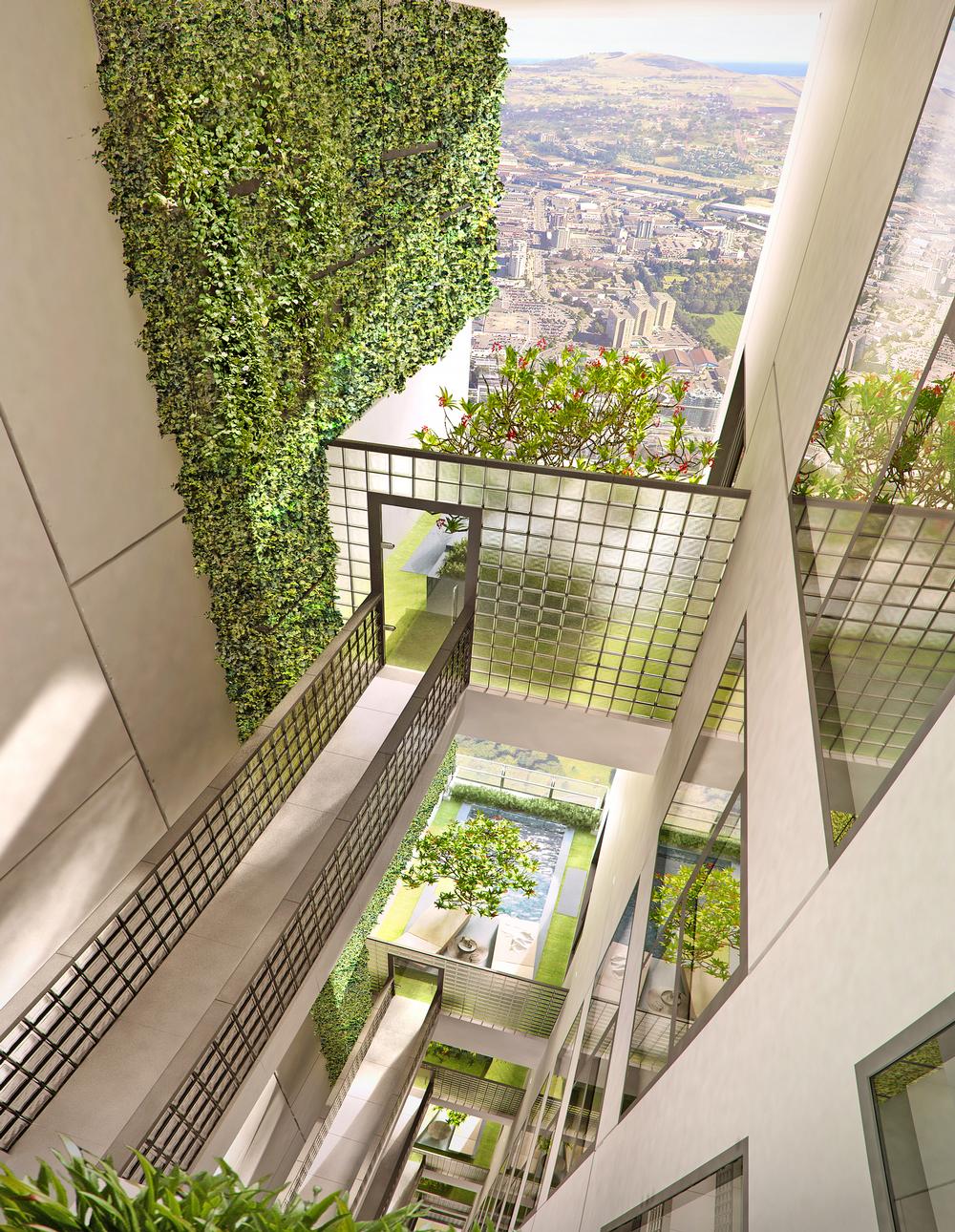
With this in mind, Parkroyal on Pickering maximises natural daylight through its open-sided courtyard configuration while vertical greenery shields the hotel’s west-facing walls to keep them cool and prevent heat radiating into guest rooms. Corridors, lobbies and washrooms have been arranged with planting and water features to generate more natural light and fresh air, avoiding them turning into 24-hour energy-guzzling spaces. In fact, there is no air-conditioning installed in external corridors but with the combined shading from sky trees and overhanging plants as well as radiant heat absorbed by vertical greenery, the ambient temperature is always cooler than outside the building. Lush landscaped terraces and sky gardens, planted with species selected for their durability in the tropical climate, complete the scheme.
“Studies by the National University of Singapore have shown a temperature drop of 3.3?C behind green walls, which means that developers in tropical climates are less reliant on air-conditioning to keep their buildings cool,” says Hassell. “Alongside this resulting reduction in electricity bills, other benefits of a green scheme are the ability for areas such as landscaped gardens and rooftops to be hired out as event spaces, generating revenue in their own right.”
As an architecture and design practice that works closely with operating teams, WOHA is all too aware of the practical issues that can arise with vertical greenery.
“In the case of some green walls, we’ve seen owners forced to hire a maintenance gondola simply to replace a dead plant,” Hassell adds. “So we’ve divided the Parkroyal building into blocks with linkways and terraces to allow ease of access for a gardener and a wheelbarrow to attend to every section of planting. The selection of low-maintenance plants such as ferns and palms, coupled with an automatic irrigation system, minimises the needs for constant maintenance. Currently gardeners are scheduled to conduct checks and regular trimming twice a week across the property.”
As well as the hotel’s self-sustaining irrigation system, which collects rain to water the plants, rooftop solar panels power the grow lamps and softscape lighting installed throughout the landscaping.
New Cuffe Parade
This holistic approach to design is undoubtedly at home in a country known as the garden city-state but perhaps its application makes most sense in those cities under threat of losing their green spaces.
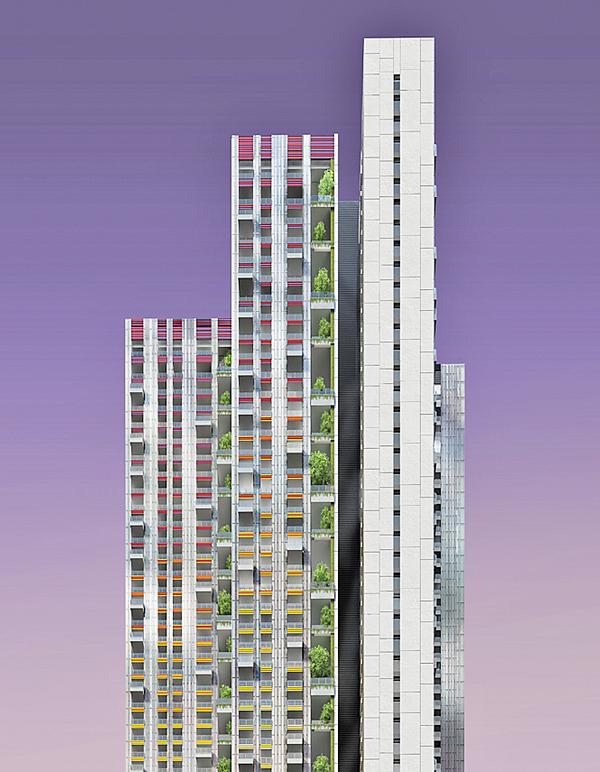
Mumbai, a case in point, is the site of a high-rise residential complex with Indian developer Lodha Group. New Cuffe Parade in the Wadala district comprises 10 64-storey residential towers and a commercial tower, clad in a shimmering aluminium screen that diffuses light and creates shade. Apartments overlook a 10-hectare recreational garden while the external façades are dressed in vertical green walls. It’s the first time a green high-rise of this ambition and scale has been attempted in Mumbai, says Hassell.
Meanwhile WOHA’s mission continues, now over in Phuket. Aiming for LEED certification from the US Green Building Council, Rosewood Phuket is being constructed according to passive design principles. Large overhangs are a characteristic of the building structures, cross-ventilated spaces are commonplace and all existing trees have been secured and incorporated into the design. Photovoltaic cells for energy collection, massive water-storage dams embedded into the landscaping, reverse osmosis water-filtration systems, grey water recycling and coral reef restoration are some of the additional features that will ensure this resort, due for completion in 2017, moves the green hospitality agenda forward.





Designed to restore neglected land and renew the identity of Iraq’s capital city, Baghdad Sustainable Forests promises a new way of living surrounded by nature. Gensler’s Ian Mulcahay tells us why he thinks the project could become a model for the repair and enhancement of urban centres