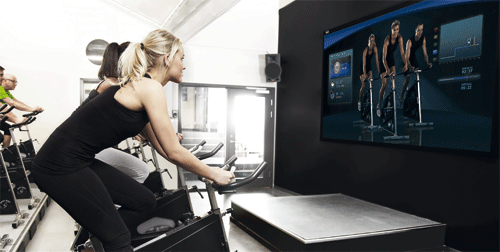
Virtual classes
Virtual reality
Are virtual classes bringing a new lease of life to group exercise studios? Rasmus Ingerslev takes a look at this growing trend



Virtual classes, teacherless classes, video-based classes – this new phenomenon, seen in both group exercise and cycling studios, is growing fast and has many labels. But what is it exactly: how can it be used, how does it work, and what is its value?
A strong logic
To start with the why, imagine investing in 30 treadmills and turning them off for 70 to 80 per cent of the day. It wouldn’t make sense, would it? Yet the same thing is effectively happening in group exercise and cycling studios around the world, which are not in use for 70 or 80 per cent of the day.
There is, of course, an obvious reason for that: any club will always consider the potential number of members who would be able to attend a class before putting it into a schedule and taking on the cost. It simply doesn’t make sense to offer live classes during the majority of the day. This is where virtual classes come into their own, allowing studios to add value to the club throughout the day – members can do the classes they want, when they want, while clubs optimise the use of expensive floor space and bikes they are already paying for.
Surveys in the UK and the Nordics (over 1,100 responses) suggest that, in clubs with a virtual offering, around two-thirds of new members have been influenced in their buying decision by the fact that classes are available throughout the day.
“Utilising dead space by offering classes all day will no doubt sell additional memberships for us and add value for our close to one million members – without detracting from the quantity or quality of our live class experience,” agrees David Patchell-Evans, CEO and founder of GoodLife Fitness in Canada, which is currently trialling virtual classes in six of its 300 sites. “We will ultimately add something like 25,000 virtual classes a week across all clubs, at a minimal cost.”
It’s too early to tell if virtual classes can also benefit retention. However, with numerous reports – IHRSA’s guide to membership retention, for example – and myriad anecdotal evidence indicating that retention rates are higher for group fitness members than for gym-only members, it’s likely that virtual classes will have a positive impact on retention as well as new member acquisition.
How does it work?
The technical set-up for a virtual class system is very straightforward: you basically need a screen, a projector and a computer connected to the internet that stores and runs your classes. It’s typically possible to run the sound through the existing audio system in your group exercise studio.
There are currently a number of systems on the market, such as Fitness On Request, Fitness On Demand, MyRide (cycling only), Virtual Instructor (from Cyber Coach) and Wexer Virtual. Most systems allow clubs to either pre-schedule classes or let members choose classes on-demand. Since most clubs will not allow a single member to decide what happens in the group exercise or cycling studio – at least during hours where more participants are expected – most clubs prefer either only pre-scheduled classes or a combination of pre-scheduled and on-demand. The benefit of offering pre-scheduled classes is that clubs can promote an extensive group exercise schedule that can exceed that offered by the competition.
Prices for installing a virtual class system vary, but the cost is typically in the region of US$3,000–20,000 (£2,000–13,000 / €2,350–15,600). Most providers also charge a monthly licence fee, typically ranging from US$100–300.
Substitution or addition?
Like other offers in gyms, virtual classes are not a ‘one size fits all’ feature and judging from user feedback, instructors should not feel threatened in any way. Fewer than 10 per cent of participants say they prefer video-based instruction to a live instructor, and most choose virtual classes simply because it allows them to participate in a class when no live options are available. Indeed, statistics show that the majority of those who participate in virtual classes also participate in instructor-led classes, suggesting that members will do live classes when they can, and virtual classes at other times.
Based on available data, the average member uses a virtual class once or twice a week, typically a 30- to 45-minute beginners’ or intermediate class. Longer and/or more advanced classes are available but less used, suggesting that virtual classes appeal predominantly to members who are either new to group exercise or who need flexibility to fit in more group exercise workouts on a weekly basis.
Although virtual classes can work as a standalone solution – in budget clubs where the model does not allow for live classes, for example – in most sites it’s more likely they will serve as ‘feeders’, ultimately driving traffic to live classes.
Zumba Fitness has recently started to offer Basic Steps videos to virtual content platforms for this very reason: the videos allow members to learn and practise the steps in preparation for joining a live class with an instructor. “Our decision to offer Basic Steps videos on virtual content platforms is consistent with our mission to make our instructors successful,” says Alberto Perlman, the founder and CEO of Zumba Fitness.
Phillip Mills, CEO of Les Mills International, agrees: “Our research has revealed a correlation between members moving on to live group exercise classes after trying virtual workouts. In that sense, technology will act as a feeder to the live experience.”
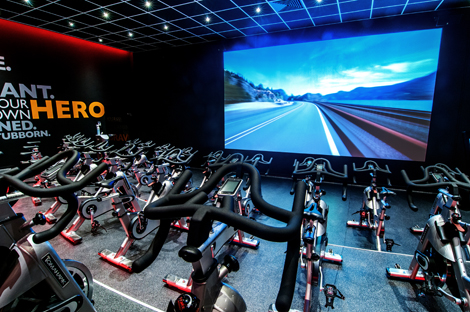
Virtual class systems can also be used to enhance live classes. Take Virtual Active: a first-person, forward-motion video experience designed to enhance cardio workouts. The videos feature iconic trails, roads, cities and landscapes, helping turn indoor exercise – instructor-led cycling classes, for example – into an outdoor adventure.
As another example, think of a traditional group exercise class for beginners with more than 30 people attending. This would be a challenging task for any instructor, since giving each individual the attention the instructor would like is difficult to achieve without leaving the rest of the class to fend for themselves. However, if the class were virtual, an additional live instructor would be freed up to fully focus on the attendees without having to worry about anyone being left behind when giving one individual special attention.
Additional considerations
A significant consideration – besides choosing a system that’s stable, well supported and easy to use – is content. Members will want high quality classes, great instructors and variety in level, duration and type of classes.
Some would argue that, for health and safety reasons, beginners should not do a class without a live instructor present. However, Fresh Fitness Denmark has offered virtual classes for more than two years, without a single injury reported. Meanwhile, the cardio areas and strength machines in most clubs are not supervised constantly, with members working out unsupervised. Why shouldn’t that also be acceptable in a studio where, thanks to virtual classes, members are in fact also receiving guidance from top instructors?
This calibre of trainer is another selling point: virtual classes offer access to world-class instruction and a huge variety of trainers. Virtual systems could also be used to complement training for existing staff, exposing them to best practice from leading instructors.
Future trends
We have not yet reached tipping point with virtual classes, but given their ability to generate value from dead space, it’s likely that more clubs will incorporate them into their offering going forward. The fact that major brands such as Zumba and Les Mills have entered the virtual arena suggests that it’s on the brink of rapid growth.
Not only that, but the virtual class system is a customer-focused innovation that mirrors those in other industries – innovations such as Netflix, which allows customers to watch what they want, when they want to watch it, and which is challenging the traditional cable TV providers that force viewers to follow their programme schedules. Similarly, virtual classes allow members to do the classes they want, when they want to do them. Operators can therefore meet, and indeed exceed, customer expectations by laying on hundreds of additional classes every week – all for the price of a couple of treadmills. Not that it is an either/or question, but operators might want to ask themselves which would give the stronger competitive advantage.
“Convenience is key, and virtual workouts where participants are guided by on-screen instruction will become prevalent,” concludes Mills. “Originally I was something of a sceptic on non-instructor-led exercise, but having trialled a virtual product at Les Mills I’m now a convert. Offering members the convenience of receiving a group exercise experience at any time of the day is compelling. For clubs, it’s a massive way to add value as facilities increasingly become 24/7 operations.”
Rasmus Ingerslev is the CEO of Wexer Virtual, which has clients in the UK, US, Denmark, Norway, Sweden, Canada, Australia and New Zealand. He is also CEO of Fresh Fitness Denmark and a newly appointed member of the IHRSA board of directors.
Email [email protected]
Web www.wexervirtual.com
LinkedIn www.linkedin.com/in/ringerslev





















Designed to restore neglected land and renew the identity of Iraq’s capital city, Baghdad Sustainable Forests promises a new way of living surrounded by nature. Gensler’s Ian Mulcahay tells us why he thinks the project could become a model for the repair and enhancement of urban centres