News report
From strength to strength
New GWI research indicates the global wellness economy has smashed previous records to reach US$6.3 trillion at the peak of the ‘wellness decade’. Katherine Johnston and Ophelia Yeung present the highlights




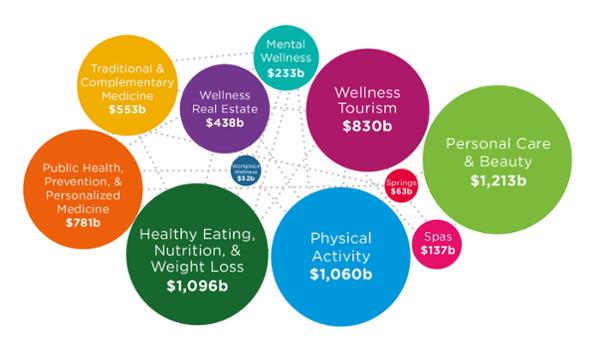
The global wellness economy soared to a valuation of US$6.3 trillion (€5.99 trillion, £4.98 trillion) in 2023, marking its third consecutive year of remarkably strong growth and recovery in the post-pandemic period. We project continued robust expansion, with the wellness economy expected to reach US$9 trillion (€8.6 trillion, £7.1 trillion) by 2028, nearly doubling its 2019 size.
This equates to a compound annual growth rate (CAGR) of 7.3 per cent from 2023 to 2028, significantly outpacing the global GDP growth forecast of 4.8 per cent annually. At this point, the wellness economy will account for 6.8 per cent of global GDP.
Nine of the 11 wellness sectors – including the spa industry – have already surpassed their 2019 market sizes and wellness markets across every global region experienced strong growth between 2019 and 2023.
Ones to watch
These markets will grow the fastest by 2028, GWI says:
◆ Wellness real estate: +15.8 per cent annually
◆ Mental wellness: +12.2 per cent annually
◆ Wellness tourism: +10.2 per cent annually
◆ Thermal & mineral springs: +9.2 per cent annually
◆ Healthy eating, nutrition & weight loss: +6.4 per cent annually
The spa sector is also expected to increase 6.1 per cent a year by 2028, reaching US$184.3 billion (€175.09 billion, £145.73 billion). By then the personal care & beauty, healthy eating, physical activity, wellness tourism and public health & personalised medicine markets will each surpass US$1 trillion (€950 billion, £790.7 billion).
Driving forces
Senior GWI researchers Katherine Johnston and Ophelia Yeung presented the new findings at the recent 2024 Global Wellness Summit in Scotland (see p86). They noted that several enduring trends – including an ageing population, rising rates of chronic disease and widespread mental health challenges – are propelling the wellness economy forward.
“Despite declines in global wellbeing on several fronts, the wellness economy continues to thrive, demonstrating the growing consumer focus on health and self-care,” they said.
To underscore the industry’s scale, GWI compared it to other major sectors, revealing that the wellness economy is now larger than the pharmaceutical, sports, IT, tourism and green economy industries.
Top-performing sectors: 2022–2023
All 11 wellness sectors saw positive growth from 2022 to 2023, with the following leading the way – wellness tourism: +30.3 per cent; spas: +29.3 per cent; and thermal/mineral springs: +28.7 per cent.
This rise reflects a post-pandemic surge in wellness travel, as these sectors had suffered significant setbacks during the pandemic.
Long-term leaders: 2019–2023
Between 2019 and 2023, the sectors with the highest average annual growth rates were:
◆ Wellness real estate: +18.1 per cent
◆ Public health, prevention & personalised medicine: +15.2 per cent
◆ Mental wellness: +11.6 per cent
◆ Healthy eating, nutrition & weight loss: +4.7 per cent
◆ Wellness tourism: +4.5 per cent
Wellness real estate emerged as the standout, driven by an increasing awareness of how physical environments influence mental and physical health.
Regional market insights
Since the pandemic, all global regions have experienced wellness market growth, with the top performers being:
◆ North America: 137 per cent of its 2019 size
◆ Middle East-North Africa: 130 per cent of 2019 levels
◆ Europe: 125 per cent of 2019 levels
The largest regional wellness markets are North America at US$2.2 trillion (€2.09 trillion, £1.74 trillion), Asia-Pacific at US$1.9 trillion (€1.81 trillion, £1.5 trillion) and Europe at US$1.7 trillion (€1.62 trillion, £1.34 trillion). Together, these account for more than 90 per cent of the global wellness economy.
A ‘wellness decade’ in retrospect
Between 2013 and 2023, the wellness economy grew at a CAGR of 6.5 per cent, a period GWI researchers dub “the wellness decade”. Consumer interest in wellness has shifted from a trend to a permanent, explosive global movement, with significant growth anticipated well into the future.