Research
All in the mind
Mental health was declining even before COVID, but the pandemic has left a tsunami of mental health issues in its wake. While health care systems struggle to cope, the fitness industry could help...




According to the Office of National Statistics, around one in six (17 per cent) of adults aged 16 years and over in the UK experienced some form of depression in the summer of 2021. This is a 7 per cent leap from the year pre-COVID (July 2019 to March 2020), when 10 per cent of adults experienced some form of depression.
In the US, Johns Hopkins Medicine estimates that 26 per cent of adults suffer from some form of mental illness. The US Centers for Disease Control and Prevention reckons that percentage has doubled since the start of the pandemic.
The pandemic affected mental health in two ways. People rely on connectivity and coping skills to support their mental wellness, but COVID imposed isolation, which sometimes led to loneliness and cut off access to many of the activities and amenities which people use to maintain their mental health.
According to the findings of the John W Brick Mental Health Foundation’s Move Your Mental Health Report, which analysed 1,000 scientific studies published over the last 30 years on the link between exercise and mental health, routinely moving our bodies helps us to build mental and emotional wellbeing and is indisputably associated with mental health benefits.
A new approach
Traditionally, mental health has been thought of as a horizontal continuum, with little or no mental illness at one end, mild mental illness in the middle, and severe (high) levels of mental illness at the other. The main forms of treatment in this model are medication, psychoanalysis and institutionalisation.
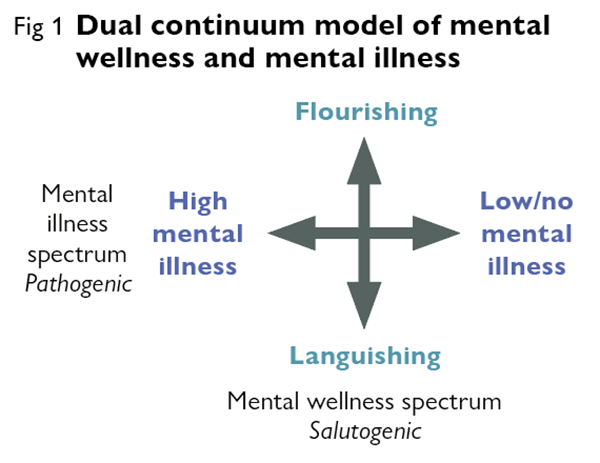
However, in the new Dual Continuum Model, developed by the Global Wellness Institute, (as shown in Fig 1) there are two continuum. The first is the traditional ‘horizontal’ approach which treats mental health issues as being pathogenic in nature and deals with the ‘disease’ of mental illness. This approach is focused more on the physiology of the condition and involves conventional clinical care.
The second, vertical continuum is salutogenic in nature – an approach which focuses on health rather than the disease and involves more holistic approaches, such as self-care. This model ranges from ‘languishing’ at the bottom to ‘flourishing’ at the top.
A person can struggle with mental health issues (languishing) due to external factors such as poor lifestyle choices, external stress and life events, even though they don’t have a clinical mental illness.
Conversely, a person can be flourishing even if they have a clinical mental illness. For example, if they have a good diet, exercise regularly and have manageable stress in their life, they can be happy and productive, even while having a mental illness such as schizophrenia.
Languishing members
As exercise and physical activity are salutogenic – about wellness and self-care – the health club industry has an essential part to play in the vertical continuum.
Most health club members who are suffering from mental health issues will be languishing because of external factors and/or poor self-care, not because of clinically diagnosed mental health issues. These are the people who will benefit from exercise the most.
The Move Your Mental Health Report found research overwhelmingly supports the beneficial role of exercise and physical activity in addressing mental health issues, particularly depression and anxiety – the two conditions which have been most exacerbated by the pandemic.
In the UK, the National Institute for Health and Care Excellence (NICE) has echoed the need for exercise to be considered for mild mental health issues. In draft guidance released last year, the organisation recommended that a “menu of treatment options” – including physical activity – should be offered to all patients before medication is considered. Ideally, those suffering from mild depression should be offered exercise, mindfulness, talking therapy or meditation before medication.
Dr Paul Chrisp, director of the centre for guidelines at NICE, said: “People with depression deserve and expect the best treatment from the NHS which is why this guideline is urgently required.
“The COVID-19 pandemic has shown us the impact depression has had on the nation’s mental health. People with depression need these evidence-based guideline recommendations available to the NHS, without delay.”
Mindful start-up
Mind Labs is one start-up which has already stepped into this place, with a £7.99 per month app. This new mental health platform hopes to make looking after mental health “as normal as going to the gym” and empower everyone with the tools to take better care of their minds.
A mental wellness platform backed by neuroscience, Mind Labs uses live and on-demand content to help people manage stress, anxiety and low mood and to help improve their sleep patterns, by helping users to rewire their brains.
It utilises expert knowledge from mindfulness practitioners and experts who have skills ranging from breathwork, neuroscience and clinical psychology.
Co-founder and CEO of Mind Labs, Adnan Ebrahim, said: “For far too long, we’ve neglected taking care of our minds in the same way we take care of our physical selves. We’ve been ashamed to speak openly about this, mislabelling mental vulnerability as weakness and approaching practices such as mindfulness with caution, worried about its scientific vigour.
Ebrahim says Mind Labs is excited to be the new face of change: “Our team of neuroscience and mindfulness experts lead classes based on research, making techniques which previously felt out of reach, practicable and understandable. It’s time for us to reclaim mental wellness and bring tools such as meditation and breathwork into the mainstream with a science-first approach.
Mind Labs’s head of mindfulness, Anne-Sophie Fluri, says: “Video content gives us the opportunity to truly connect with users, even when we’re not in the same physical environment.
“Mind Labs is a daily tool to strengthen neural pathways which lead to better concentration, improved presence and self-awareness and more positive thinking patterns.”
• Hold a team meeting to educate your team aon the growing mental health crisis and the role health clubs can play in mitigating it.
• Discuss the dual continuum model and the essential role exercise and movement plays in the salutogenic/wellness continuum. Emphasise the importance of positive stress in improving physical and mental wellbeing – understanding that positive stress is different for each individual. Too little stress is as undermining as too much stress.
• Promote individual and group personal training as a mental health benefit to members, not just as an effective way to get in shape.
• Offer a wide variety of shorter classes – 30 to 45 minutes – to encourage more frequent visits and workouts. Lack of time is usually given as the main reason for not exercising.
• Combine cardio with strength training by utilising interval training in shorter cardio workouts, combined with appropriate moderate to strenuous strength workouts. It’s possible to get a very good workout in 12-15 minutes on a piece of cardio, employing proper interval training techniques based on heart rate. Circuit training is also an effective way to combine cardio and strength training in a short, efficient workout.
• A proper schedule of workout days and complete rest days is important, as the gains are made in recovery. Sometimes, it’s important to do nothing.
• Be keenly aware of the role of rest and recovery in maintaining good mental health. Encourage members and your team to include yin activities such as stretching, yoga, pilates and Tai Chi in their exercise routine, as well as yang activities such as cardio, strength training and swimming.
• No matter where people are on the mental health spectrum, they can move themselves toward greater mental wellness by creating an ecosystem of mental wellness that includes the interlocking ‘building blocks’ they need to build their mental and emotional resilience. Among many other factors, these include regular exercise, a social support network and a well balanced diet. The more building blocks are added, the more people find themselves moving toward greater mental resilience and emotional wellbeing.

• Exercise is strongly associated with general mental and emotional wellbeing, including reduced stress and improved mood and quality of life.
• Evidence strongly supports cardiovascular/aerobic exercise for reducing depression.
• Yoga and other mindful exercises such as Tai Chi and Qigong show strong evidence for reducing symptoms of anxiety and depression.
• Frequency is more important than duration. Three to five 30-45 minute moderate to vigorous exercise sessions per week appear to deliver optimal results. The key words are ‘moderate to vigorous’, as this supports the concept of positive stress.
• Too much exercise can increase anxiety. People who exercise three to five times per week show better mental health than those who exercise less than three or those who exercise more than five.
• High intensity exercise is generally more effective than low intensity in improving state of mind and enhancing mental health.
• Vigorous exercise has been shown to be the equivalent of an entry-level dose of an antidepressant such as sertraline.
• Cardio is the best individual form of exercise for depression and anxiety, but a combination of cardio and strength is even more effective.
• Initially, individual instruction is most effective for improving mental health but over time group training can be just as beneficial due to the increased connectivity of being part of a group.
• Mindfulness-based activities such as yoga and Tai Chi deliver more mental health benefits than walking.
• Team sports, cycling, aerobic or gym-based exercise are the top three forms of exercise associated with more than 20 per cent fewer ‘poor mental health’ days per month.