Retention
Does it matter what I say?
Dr Melvyn Hillsdon investigates the effectiveness of different types of interaction on member retention




If fitness staff interact with members, they retain their membership longer than members who receive little or no interaction. This is something we’ve shown many times. But when presenting these results, we’re frequently asked: “Does it matter what I say?”
Here we examine different interactions, and whether or not they’re associated with differences in retention rates for members considered at high risk of cancelling. (See ‘Interaction categories A–E’, below, for the five types of interaction.)
Boosting attendance…
In the study, members made an average of 3.3 visits to their club each month. On average, one of these visits each month was classed as high risk. Only 15 per cent of members made no high-risk visits during the life of their membership.
Forty-eight per cent of high-risk visits involved no interaction. In the 52 per cent that did receive an interaction:
• 14 per cent were ineffective (type A)
• 43 per cent were effective non-commitment interactions (type B)
• 9 per cent were ineffective commitment interactions (type C)
• 17 per cent were seven-day effective commitment interactions (type D)
• 17 per cent were effective commitment interactions on the nominated day (type E)
Overall, 77 per cent of interactions led to a repeat visit either within seven days of the interaction, or else on the commitment date; effective interactions with high-risk members increase visit frequency – and this, we know from prior research, increases retention.
...And Driving Retention
So to what extent does it boost retention? Members who make a high-risk visit in any given month have approximately a 5 per cent chance of cancelling in the subsequent month. However, the type of interaction they receive at the club can positively impact this – and if the interaction leads to a subsequent visit in the next seven days, or on the date the member has committed to attending, the reduction in risk is significant.
Compared to members who receive no interaction at all:
• Those receiving a type A interaction have a 16 per cent lower risk of cancelling in the next month
• Those receiving a type B interaction have an 86 per cent lower risk
• Type C interactions make no difference – positive or negative – compared to no interaction at all
• Those receiving a type D interaction have a 19 per cent lower risk of cancelling in the next month
• And those receiving a type E interaction have a 55 per cent lower risk
If all high-risk member visits were to receive an effective interaction, 73 per cent of all cancellations in this group of members would be avoided.
The price of silence
Let’s estimate the lifetime income based on a sample of 1,000 members.
In Table 1, the number of members in each interaction group is based on the actual distribution in the full sample of 13,722 members. In Table 2, we’ve reduced the number of members who receive no interaction and increased the number who receive effective interactions.
The income is estimated by multiplying the number of members in each group by the length of membership (based on the retention rate for each group) and then by a monthly fee of £35.
For every 1,000 high-risk members, the revenue from membership dues would increase by approximately £112,595 – 36 per cent – if interaction levels were improved as indicated in these tables.
A change of role?
For every 12 effective interactions that fitness staff deliver during high-risk visits, one membership cancellation is prevented. It could therefore be argued that the primary role of fitness staff should be to sell repeat visits.
So what does it take to switch the focus of your staff in this way?
Fitness staff could be more successful at getting health club members to return within a week of speaking to them if they adopted motivational strategies that are integral to the technique of motivational interviewing (MI).
MI practitioners aim to elicit a client’s own reasons for change, known as ‘change talk’. This is because the more clients make their own case for change, the more likely they are to actually change. The reverse is also true: the more people feel they’re being coerced into a change of behaviour, the less likely they are to do it.
Similarly, if fitness staff were to become more skilled at eliciting members’ own reasons for making a repeat visit, the odds of it actually happening would be expected to increase – this compared to fitness staff advocacy for a repeat visit, which typically results in counter-argument from the member and a lack of change. The risk with the latter is that members agree to a repeat visit date simply to appease the staff, but without a genuine commitment to attend again.
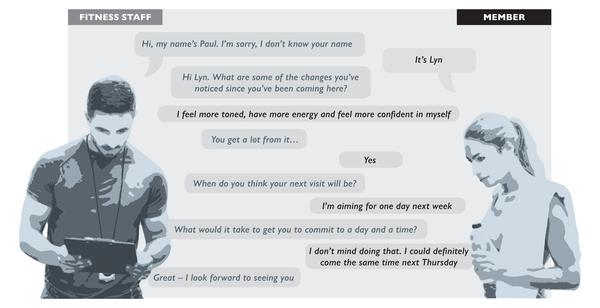
This doesn’t need to be a complicated conversation; it could be as simple as asking the member to list some of the changes they’ve noticed since coming to the gym, which encourages them to recognise the benefits for themselves and be more open to a repeat visit. See Figure 1 (below).
Step forward technology?
An inevitable question in this digital age is whether these interactions could actually be automated – delivered by an app or wearable device. At this stage I would suggest not: research into the effectiveness of behaviour change interventions has consistently highlighted the positive effect of practitioner empathy, independent of other aspects of the intervention.
Digital interactions can be tailored, but cannot currently convey empathy or be as personalised as human interactions. In addition, although wearables incorporate behaviour change techniques including self-monitoring and feedback on performance, the focus is on providing external motivation.
Certainly, despite their ubiquity, there’s an absence of research into the impact that wearables may have on changes in physical activity, although some trials are currently underway.
It’s possible that the best solution is a combination of interpersonal and digital communication, although at present the best evidence is for the effect of interpersonal interactions on both changes in behaviour and membership retention.
However, improving both the quantity and the quality of fitness staff interactions with members won’t just happen by chance. Staff will need specific training, and clubs will need to invest in software solutions to assist fitness staff in identifying high-risk members, monitoring interaction levels and tracking progress.
Action points
• Identify at-risk members when they make a visit to your health club, and target them for interaction – the goal being to get them to commit to a subsequent visit within a week.
• Train health club staff in different types of member interactions, as well as different methods of motivating high-risk members to make a repeat visit.
• Monitor the types of interactions that health club staff have with high-risk members and the proportion of these interactions that lead to a repeat visit.
Interaction categories A–E
Fitness staff at clubs participating in the research regularly reviewed the ‘who’s in the club’ page of the software being used for the study. This displayed members’ photographs, risk of drop-out and any recent interaction history with staff at the facility. Armed with this information, staff could locate members at high risk of cancellation, have a conversation with them and then quickly and simply record the main points of each conversation on the software.
Each high-risk club visit was classified as either receiving no interaction, or else one of the following five interaction types:
A. Ineffective interactions: An interaction that didn’t ask a member to commit to a repeat visit, and that didn’t lead to a repeat visit in the next seven days.
B. Effective interaction: An interaction that did lead to a repeat visit in the next seven days, even without asking the member to commit to one.
C. Commitment interaction: An interaction during which the member committed to attend again on a fixed date, but didn’t subsequently attend on that date or within seven days of the interaction.
D. Effective commitment interaction: An interaction during which the member committed to attend again on a fixed date – and although they didn’t actually attend on that date, they did attend within seven days of the interaction.
E. Successful commitment interaction: An interaction during which the member committed to attend again on a fixed date and did attend on that date.
Data for analysis included 13,722 members with joining dates between June 2010 and January 2012. Members were followed up to track cancellations between one and 14 months.
TABLE 1:
INCOME BASED ON CURRENT LEVELS OF INTERACTION
Calculations based on membership fees of £35 a month
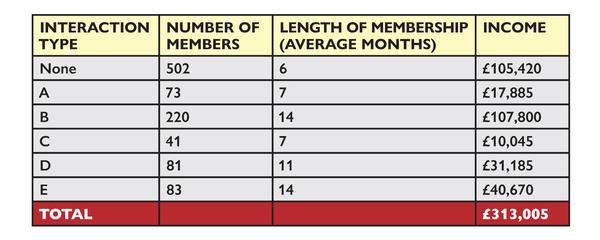
TABLE 2:
INCOME BASED ON IMPROVED LEVELS OF INTERACTION
Calculations based on membership fees of £35 a month
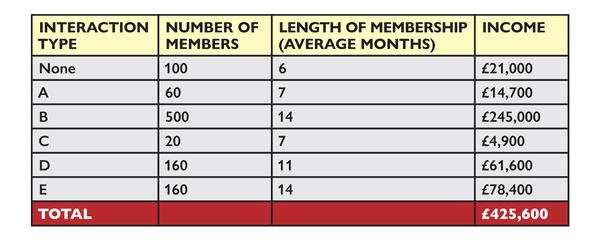
Figure 1:
Commitment interactions don't need to be complicated
About the author

Dr Melvyn Hillsdon is associate professor of exercise and health at the University of Exeter, where he researches physical activity and population health. Since his landmark retention report in 2001 (Winning the Retention Battle), he has published numerous reports into the determinants of membership retention.












Designed to restore neglected land and renew the identity of Iraq’s capital city, Baghdad Sustainable Forests promises a new way of living surrounded by nature. Gensler’s Ian Mulcahay tells us why he thinks the project could become a model for the repair and enhancement of urban centres