Retention series
New year, new strategy
Targeting older members, focusing on interaction and friendship, reducing queueing and incorporating group exercise. Dr Melvyn Hillsdon offers his top five new year’s resolutions for clubs looking to improve member retention levels




What will your club do differently when it comes to member retention this year, and how might this impact your bottom line?
During 2014, Health Club Management published a number of articles reporting on the results of the TRP 10,000 study – a longitudinal study of 10,000 members, conducted by myself in conjunction with The Retention People, which was designed to understand member behaviour at all points of the member journey, and how different factors influence retention. In the HCM series, we highlighted a range of factors that are positively associated with membership retention – including motivation, progress, group exercise, hassles and uplifts, and communication.
In this article, we’ll pull together the lessons learned so far into a strategy for 2015. The focus will be on the financial gain from improved member retention and potential memberships saved.
Data and analysis
To estimate income from member dues, we’ll model the effect of retention on 1,000 members over the first eight months of membership (the follow-up period of TRP 10,000). To standardise fees, we will assume all members pay a monthly fee of £50. All members pay the first monthly payment, yielding £50,000 (1,000 x £50), and from then on we can plot the income for every other month by multiplying the £50 monthly fee by 1,000 and then by the proportion of members still paying in the given month. So if 90 per cent of members survive the second month, the yield from membership dues would be £50 x 1,000 x 0.9 = £45,000.
Overall yield from 1,000 TRP members?
Eighty five per cent of TRP 10,000 members retain their membership for at least eight months. Figure 1 shows that the total yield from a sample of 1,000 members over the first eight months of their membership, based on the TRP 10,000 retention rate, would be £366,165. So how can this be improved?
Resolution 1: Develop a marketing strategy that attracts more members aged 35 years and older
Members aged 35+ have a cancellation rate that’s 50 per cent lower than members aged under 35 years. Over the first eight months of membership, based on 1,000 members aged 35+ versus 1,000 members younger than 35 years, this translates into a difference in income of £27,035 (see Figure 2).
If all members were aged at least 35 years, 30 per cent of membership cancellations would be avoided, lowering demand on sales by the same proportion. This does not, of course, mean turning new members away – rather it’s about making sure your message, imagery, offer and member experience is more attractive to this older demographic.
Resolution 2: Help members set realistic goals focused on enjoyment and friendship, and help them to achieve these goals
In previous articles, we’ve reported that members who are motivated by appearance, and who perceive they are not making progress, have a high cancellation rate, whereas members who have social motivations and report making a friend have low cancellation rates.
Figure 3 estimates the eight-month income for these two scenarios. Over eight months, the socially motivated members yield an additional £32,335 compared to 1,000 members who fail to achieve a goal of improved appearance.
Further, if all members who were motivated by appearance, but who failed to make progress, had been ‘replaced’ by socially motivated members who made a friend, 28 per cent of all membership cancellations would have been avoided.
Resolution 3: Encourage and assist members to include some group-based exercise into their routine
Members who include at least some group-based exercise in their routine are 30 per cent less likely to have cancelled over the eight-month follow-up period compared to members who never do any group-based exercise. If all members included some group-based exercise into their routines, there would be 18 per cent fewer cancellations.
Based on 1,000 members paying £50 a month, and the TRP 10,000 retention levels, the members who report at least some group-based exercise would yield an additional £12,560 in income over eight months compared to members reporting no group exercise (Figure 4).
Resolution 4: Minimise the time members must queue for equipment
Along with staff failing to talk to members, the most annoying hassle that members report is having to queue for gym equipment.
Health club and leisure centre members who say they frequently have to queue for equipment in the gym, and who find it annoying, are 50 per cent more likely to cancel than those members who do not. If no members had to queue for equipment, 5 per cent of TRP 10,000 cancellations would have been avoided.
One thousand members who never have to queue for equipment would yield £14,715 more over eight months than 1,000 members who have to queue frequently (see Figure 5).
Resolution 5: Develop a strategy to ensure both reception and fitness staff speak to members on every visit
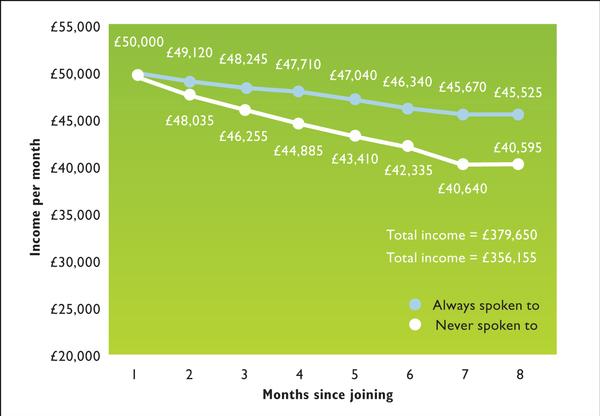
TRP 10,000 has consistently found that both reception and fitness staff have an important role to play in helping retain members. Members who report not being spoken to by either reception or fitness staff are more than twice as likely to cancel as members who are always spoken to by staff.
If both reception and fitness staff always spoke to all members, it’s estimated that 44 per cent of cancellations would be avoided. For every 1,000 members who are always spoken to by reception and fitness staff, an additional £23,495 would be yielded compared to members who are never spoken to by staff (see Figure 6).
Combining resolutions
The data presented in this article highlight the significant financial benefits of relatively small improvements in member retention – and as yet we only have eight months of follow-up in the TRP 10,000 study; the true financial gains will be even greater when taken across 18–24 months.
All of the proposed retention resolutions can be achieved at relatively low cost and are primarily operational and management issues. Therefore, the return on investment for these retention strategies will be substantial.
Of course, the effect on club-level retention of each of these five resolutions is a function of how big the risk of cancelling each resolution presents, combined with how many people experience the risk.
For example, the likelihood of an individual member cancelling in a given month if the fitness staff do not talk them is approximately 3 per cent, or 3 in 100. However, because so many members report fitness staff not talking to them, removing the risk by ensuring all members get spoken to has a much larger effect on overall retention than implementing a resolution which only affects a small number of members, even if the risk of cancelling among those individuals affected is higher.
For example, club members who report frequently queueing for equipment have a monthly risk of cancelling of around 4 per cent – but in TRP 10,000, far fewer members report experiencing this risk factor, meaning removing it saves fewer members.
When developing retention strategies, managers should therefore consider how likely the strategy is to reduce the risk of a member cancelling and how many members will be affected.
Nevertheless – while the five resolutions described in this article are independent of each other, and it’s important to prioritise the biggest wins – there’s no single ‘silver bullet’. If you’re serious about making significant and sustained improvement, the power lies in combining all the resolutions together over time.

Dr Melvyn Hillsdon is associate professor of exercise and health at the University of Exeter, where he researches physical activity and population health. Since his landmark retention report in 2001 (Winning the Retention Battle), his research into retention and attrition has led to the development of appropriate measures of retention, attrition and longevity that provide data for operators that can directly inform business decisions. In partnership with TRP, he has published numerous reports into the determinants of membership retention.
FIGURE 1 Estimated income over eight months based on TRP 10,000 retention data, from a sample of 1,000 members paying £50 a month
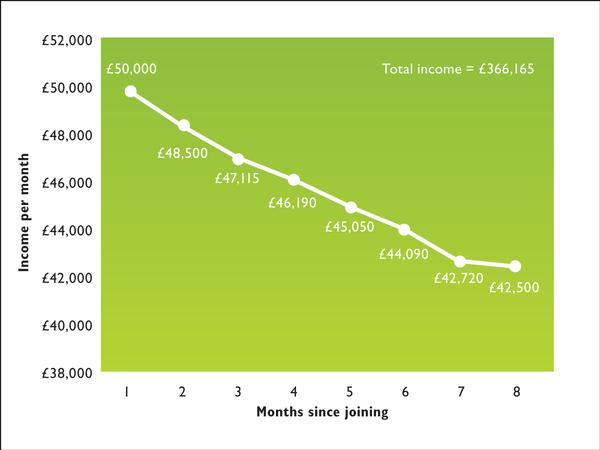
FIGURE 2 Estimated income over eight months, based on TRP 10,000 retention data, from an initial sample of 1,000 members – by age group
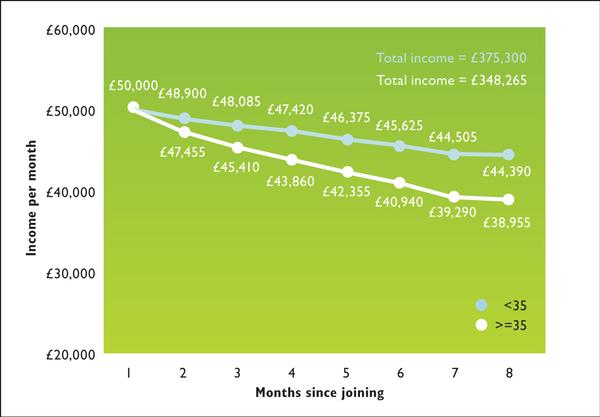
FIGURE 3 Estimated income over eight months from appearance-driven members who made no progress vs socially-focused members who made a friend – from an initial sample of 1,000 members
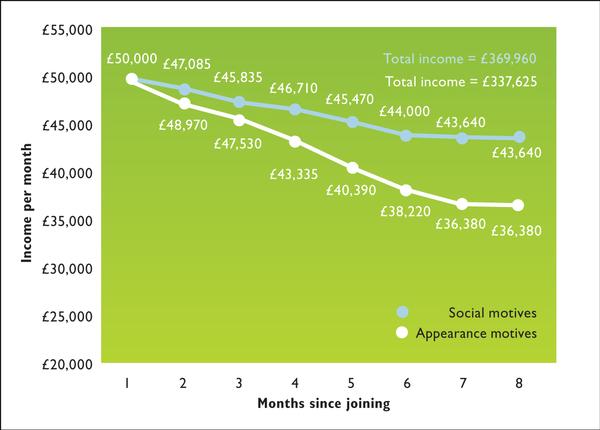
Figure 4 Estimated income over eight months, based on TRP 10,000 retention data, from members who participate in group exercise versus those who don’t, from an initial sample of 1,000 members
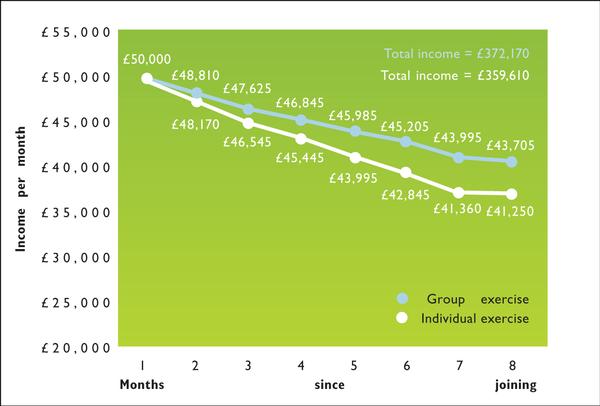
Figure 5 Estimated income over eight months, based on TRP 10,000 retention data, from members who frequently have to queue for kit versus members who don’t, from an initial sample of 1,000 members
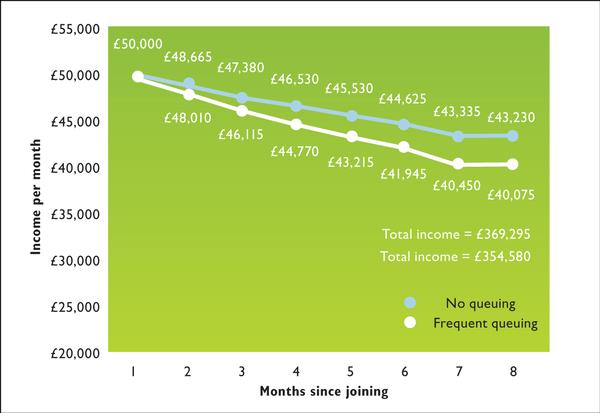
Figure 6 Estimated income over eight months, based on TRP 10,000 retention data, from members who are always spoken to by staff vs. those who are never spoken to, from a sample of 1,000 members














Designed to restore neglected land and renew the identity of Iraq’s capital city, Baghdad Sustainable Forests promises a new way of living surrounded by nature. Gensler’s Ian Mulcahay tells us why he thinks the project could become a model for the repair and enhancement of urban centres