Retention series
Interaction = progress = retention
Can fitness staff alter member progress, and does this improve retention? Dr Melvyn Hillsdon reports, in the fifth part of his TRP 10,000 series




We already know that members’ progress towards their goals is an important determinant of retention (see part three of this series, HCM July 14, p48). For each goal that members reported making progress on, their risk of cancelling in the next month fell by approximately 10 per cent.
We’ve also highlighted the beneficial effects of fitness staff interaction on membership retention (see HCM Sept 14, p42): even when members experience hassles in their clubs that increase the risk of them cancelling, the risk can be reduced if fitness staff regularly talk to members.
In this month’s article, we’ll look at the combination of fitness staff interaction, member progress and subsequent retention.
Data and analysis
Members were asked how much progress they had made in the last three months against a list of 10 possible goals, including losing weight, feeling fitter and making new friends.
The number of goals members said they had progressed on were summed to make a score between 0 and 10.
The scores were then classified as high or low progress, with the high category representing the top 25 per cent of members’ scores.
Members were also asked how frequently fitness staff spoke to them by ticking one box: always, frequently, occasionally, or never.
Member-staff interaction
So how often do staff speak to members, and who do they speak to most?
Figure 1 (see p56) shows that, overall, over a quarter of members say fitness staff never speak to them, and over 60 per cent say they speak to them less than frequently. Females are more likely to be spoken to than males.
The chances of being spoken to at least frequently increase with age, with two-thirds of members aged 16 to 24 saying fitness staff only speak to them occasionally or never (Figure 2).
Long-standing members experience greater fitness staff communication compared to new members, with 50 per cent more of the longest standing members reporting at least frequent communication compared to new members (Figure 3).
The Retention People (TRP) has shown many times that younger members and new members are at greater risk of cancelling their memberships compared to older, long-standing members. It’s therefore the most at-risk members – the people who would benefit most from fitness staff interactions – who are least likely to receive them.
Interaction, progress and retention
Meanwhile, Figure 4 shows there’s a very strong association between members’ recent progress towards their goals and the frequency of fitness staff interactions: fewer than one in 10memberswhoreportnofitness staff interaction say they have made a lot of progress in the last three months, compared to more than half of members who are spoken to by fitness staff each time they visit.
Interestingly, the relationship between staff interaction and member progress is strongest for social and enjoyment progress. Members who report frequent interactions with fitness staff are also much more likely to report they have made a new friend at the club and to say they have enjoyed exercising in the last three months (data not shown).
So does recent progress and fitness staff interaction also affect risk of cancelling? Yes it does: for members who report either high or low progress in recent months, the risk of cancelling each month reduces with the frequency of fitness staff communication (see Figure 5, p58). However, the impact of fitness staff communication is greatest among members who report lower levels of progress. Members who report lower progress but who are always spoken to by fitness staff are half as likely to cancel each month compared to members who report low progress and who are never spoken to by fitness staff. In fact, if all low progress members were spoken to at least frequently, 10 per cent of cancellations each month would be avoided. This is equivalent to 16 saved memberships each month for every 1,000 members you have.
The risk of cancelling and the chances of making good progress with goals are strongly related to how long people have been a member and how frequently they use the club – so it’s possible these two factors are what explain the reduced risk of cancelling, rather than fitness interactions and progress alone.
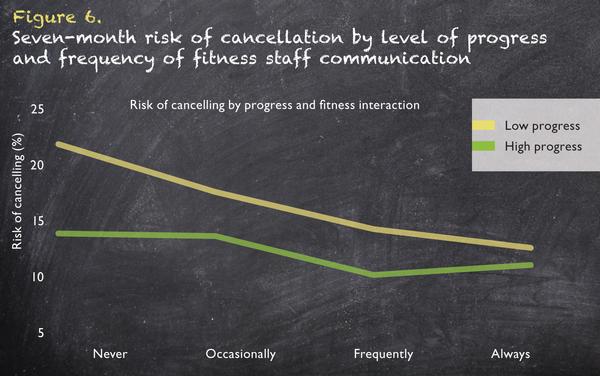
However, Figure 6 shows the absolute risk of cancelling during the seven months following the completion of the TRP 10,000 questionnaire, after taking account of how frequently members visit and their length of membership. For members who report high progress and always being spoken to, there’s approximately a one in 10 chance they will cancel, compared to a more than one in five chance of cancelling among members who report less progress and never get spoken to by staff. In other words, the negative effect of making only low progress is nearly completely cancelled out by always speaking to members when they work out.
Summary
The amount of progress members make towards their goals and the frequency with which fitness staff talk to members are both related to the likelihood of a member retaining their membership. However, these two things are interlinked and have an additive effect on the risk of cancelling.
When members receive frequent communication from fitness staff, they are more likely to make progress that in turn reduces their risk of cancelling. Members who receive more fitness staff communication enjoy the exercise more and are more likely to meet new friends at the club. Frequent communication plus high progress roughly halves the risk of cancelling compared to no communication and low progress.
Unfortunately, the members at the highest risk of cancelling are least likely to receive any communication from gym staff. Staff are most likely to talk to older, long-standing members who are making good progress. This is somewhat understandable, as these members have been around long enough for fitness staff to get to know them and are in the club more regularly than newer, younger members. Also, the older, longer- standing members are just as likely to initiate a chat as staff are with them.
But the ‘at risk’ members need targeting more to ensure they don’t miss out on essential communication with fitness staff that could help them make progress and extend the life of their membership. This needs to be systematic and not ad hoc, as a small effect on a lot of members will save the most memberships.
About TRP 10,000™
Conducted in partnership with The Retention People, TRP 10,000™ is the biggest and most comprehensive survey of member behaviour ever carried
out in the health and fitness industry: 10,000 health and fitness members completed a baseline survey of their exercise habits and membership behaviour between
July and September 2013. During regular intervals over the coming years, they will be followed up to measure changes to their habits and membership behaviour.
The respondent profile was:
* Average age 41 (16 to 85 years)
* 56 per cent female
* Half of members had been a member for at least 12 months, 25 per cent less than six months and 25 per cent more than three years
* First ever club for 25 per cent
* 24 per cent had been a member of the current club before
* 67 per cent of members used their club less than twice a week
So what should operators do?
* Ensure members frequently receive support, encouragement and motivation towards their goals from fitness staff
* Ensure staff recognise the importance of goals that are not just around physical and physiological objectives – enjoyment or social goals, for example
* Ensure members receive regular reviews of their progress and subsequent programme updates
* Develop a strategy for identifying high risk members that fitness staff should prioritise for interaction
* Encourage staff to talk to all members, not just those at lowest risk of cancelling
About the author
Melvyn Hillsdon is associate professor of exercise and health at the University of Exeter, where he researches physical activity and population health. Since his landmark retention report in 2001 (Winning the Retention Battle), his research into retention and attrition has led to the development of appropriate measures of retention, attrition and longevity that provide data for operators that can directly inform business decisions. In partnership with TRP, he has published numerous reports into the determinants of membership retention.
Figure 1.
Proportion of members reporting the frequency of fitness staff interaction, overall and by gender
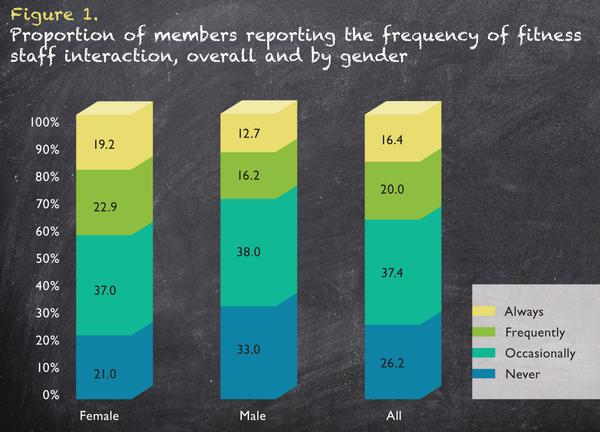
Figure 2.
Proportion of members reporting the frequency of fitness staff interaction by age group
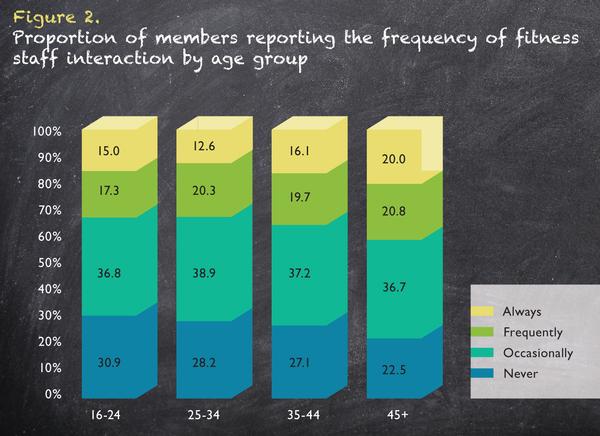
Figure 3.
Proportion of members reporting the frequency of fitness staff interaction by length of membership
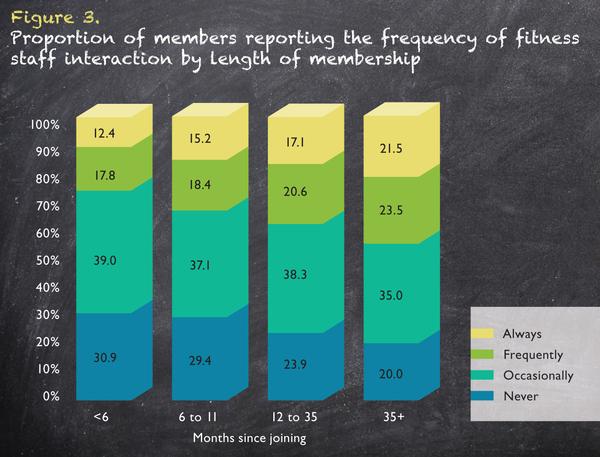
Figure 4.
The proportion of members reporting high progress in the last three months by frequency of fitness staff interaction
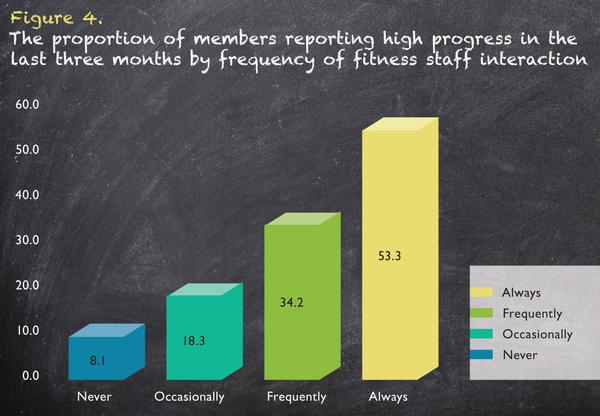
Figure 5.
Interaction between recent progress and fitness staff communication on the risk of cancelling
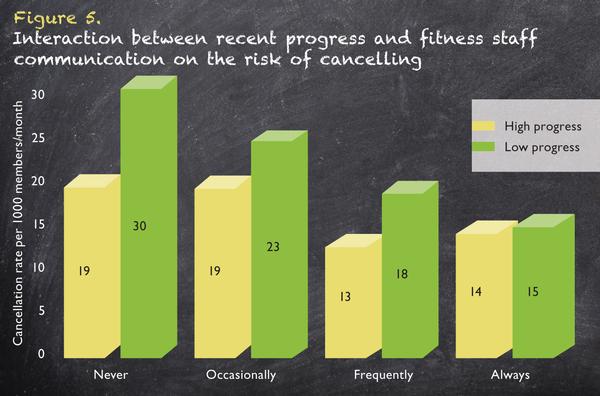
Figure 6.
Seven-month risk of cancellation by level of progress and frequency of fitness staff communication