Urban regeneration
A city reborn
From bankruptcy to boom town, Detroit is on the up again, with a regeneration fuelled by the adaptive reuse of historic buildings and innovative arts and design led projects. Christopher DeWolf finds out more



Few buildings encapsulate a city’s rise, fall and renewal as vividly as Michigan Central Station. When it opened in 1913, the 10-platform railway station stood as a monument to Detroit’s explosive ascent. The city’s population had doubled in a decade, fuelled by auto factories that would soon reshape global transportation. Michigan Central’s Beaux-Arts hall and 13-storey office tower were placed just outside the booming core, visible for miles as a promise of future prosperity.
By the time the last train departed in 1988, that promise had long since curdled. Factories had closed, crime had risen and entire blocks of the city were abandoned. The station’s shattered windows and graffiti-scarred halls became shorthand for a metropolis in freefall – a building originally hailed by local newspapers as “a sentinel of progress” now symbolised decline. In the two decades after Michigan Central closed, Detroit shed nearly half its population; in 2013, it became the largest US city to declare bankruptcy.
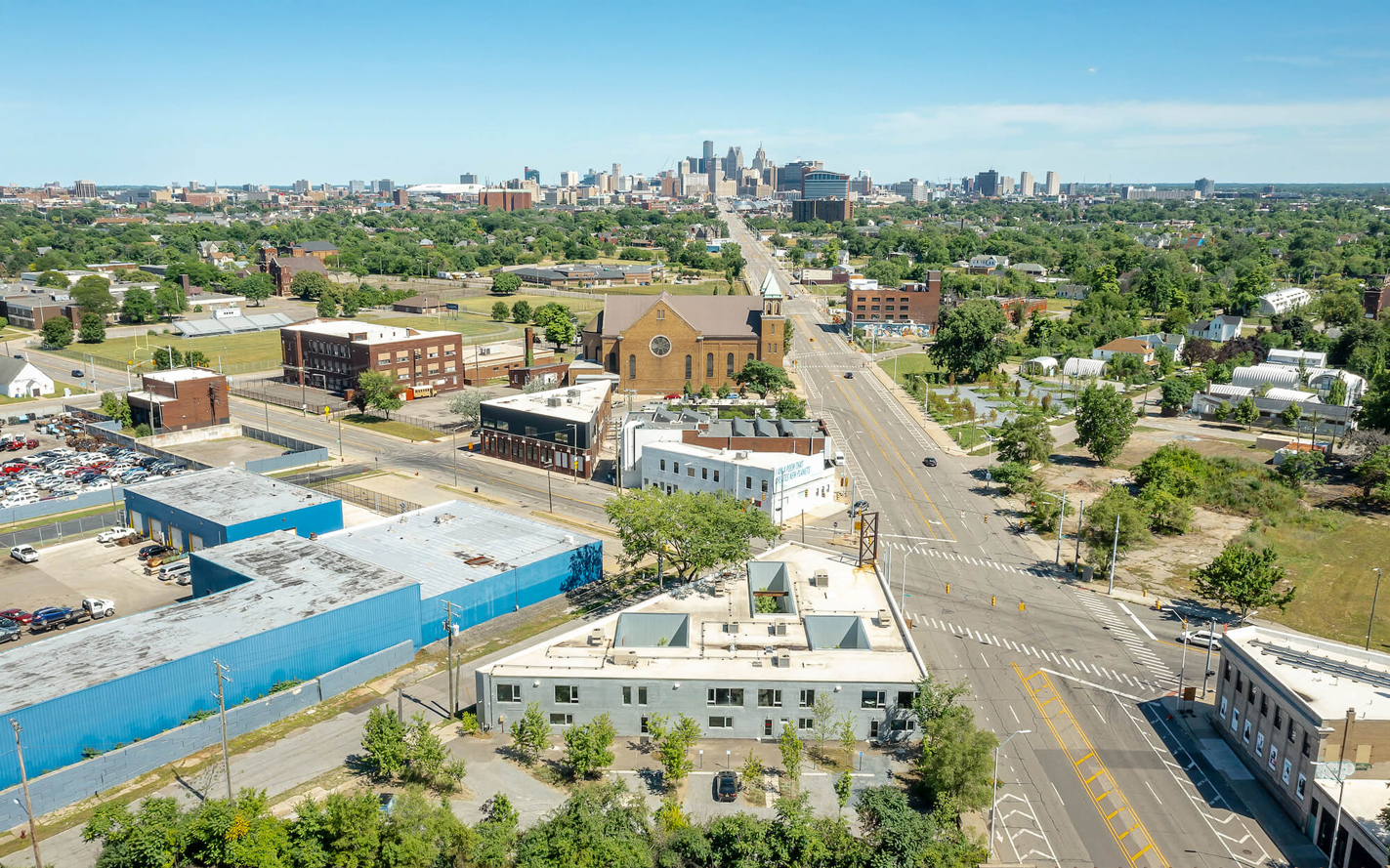
Today, Detroit’s fortunes have shifted. The population is rising for the first time since 1957. “Led by believers in the city’s future, Detroit is on the rebound,” noted The New York Times in 2024. Downtown’s historic structures are being revived, and art- and design-driven projects are taking root in neighbourhoods still dotted with empty lots.
The old story of Detroit was ‘tear it down, tear it down’. But we have serious assets here
Michigan Central has reopened at last – a mixed-use complex with offices, public spaces, event venues and a future luxury hotel. Ford Motor Company, which purchased the property in 2018, poured nearly US$1 billion into the restoration. Lost architectural elements were recreated by 3D printing; the original, long-dormant quarry was even reopened to source matching stone.
“The old story of Detroit was ‘tear it down, tear it down,’” says lifelong resident Kiana Wenzell, co-executive director of Design Core Detroit, a non-profit advocacy group that was formed after Detroit was named a UNESCO City of Design in 2025. “But we have serious assets here.”
The value of what already exists
Efforts to stop Detroit’s decline have taken many forms. One of the most conspicuous was the Renaissance Center, a colossal cluster of skyscrapers built between 1977 and 1981. It soon defaulted on its construction loans, and critic Paul Goldberger wrote in 1977 that it “sets itself apart from Detroit so dramatically” that its status as a “vote of confidence” was dubious.
A new generation of developers has taken a different tack, focusing on Detroit’s historic fabric rather than building over it. Chief among them is Detroit-born billionaire Dan Gilbert, whose firm Bedrock has acquired and renovated more than 100 downtown buildings – nearly 1.7 million square metres of floor space in a district less than two square kilometres.
People make things happen here
One flagship effort is the Shinola Hotel, opened in 2019 inside a century-old commercial block adorned with patterned terracotta tiles. Its interiors were designed by New York’s Gachot Studios, while Detroit’s Kraemer Design Group restored the façades and pedestrianised Parker’s Alley beside it, now lined with cafés and restaurants.
Bedrock’s first purchase came in 2011: the neoclassical Madison Theatre Building. From that grew an empire of restored offices, shops, residences and entertainment venues. “Over the past 15 years, Bedrock has developed deep expertise in delivering and operating historic assets,” says James Witherspoon, the company’s senior vice president of architecture and design. Through a “broad network of highly skilled consultants,” Bedrock not only preserves buildings but helps sustain the craftsmanship needed to restore them.
The impact on downtown has been transformative. Once eerily quiet after dusk and dominated by suburban commuters during the day, the core has come alive with new hotels, venues and a steadily increasing residential population. “There’s a level of business and vibrancy now that simply wasn’t here 10 years ago,” says Jennifer Skiba, Bedrock’s vice president of retail leasing.
Detroit’s fortunes have shifted. The population is rising for the first time since 1957
Because the developer controls such a large share of the area, it can shape the mix of tenants and experiences. Skiba describes a strategy that begins with high-profile anchors – the “big bang” – followed by “layered investment” in local businesses, national brands and cultural programming like Shop and See, which places installations by Detroit artists in storefront windows. “We’re focused on creating a sense of place, not just filling storefronts,” Skiba says.
Into the neighbourhoods
Detroit’s renewed centre is radiating outward. In 2012, Anthony and JJ Curis opened Library Street Collective, a contemporary art gallery in a former downtown garment district. Two years later, they reimagined the alley behind it as an outdoor art space called The Belt, which now hosts murals, installations and a cluster of bars and restaurants.
“The gallery has always looked beyond traditional exhibitions,” says Anthony. That impulse eventually turned toward entire urban blocks. On Detroit’s east side, where vacant lots often outnumber buildings – an estimated 20 percent of Detroit land sits empty – Library Street Collective began assembling neglected structures to transform into art- and design-orientated mixed-use projects. The emerging district is known as Little Village.
One anchor is The Lantern, created from a commercial bakery abandoned since the 1980s. OMA transformed the ruined building by turning its missing roof and wall into a central courtyard and drilling 1,500 holes into a blank concrete façade, giving the structure its signature night-time glow. The complex now houses a community gallery, a non-profit printing press, a craft beer bar and a clothing boutique.
Nearby, a former church has become The Shepherd, a creative campus designed by Peterson Rich Office. The architects converted the sanctuary into a sweeping exhibition space with a library devoted to Black art, repurposed the rectory as an inn, and renovated an annex into a bar and restaurant. Two detached houses now serve commercial uses.
There’s a momentum here, and it continues to build
Landscape design by New York-based OSD ties the site together. Principal Simon David says they drew inspiration from “the language of a church,” creating a phased sequence of spaces linked by a gravel “nave.” Houses are joined by a wraparound wooden porch; a sculpture park honours late Detroit artist Charles McGee; and a raised lawn adds topography to the flat terrain. The most unexpected feature is a Tony Hawk-designed skate park, conceived to attract a broad spectrum of visitors.
David aimed to design a “flexible framework for arts, community and events,” and he has watched it flourish. “It’s this constant hum of action,” he says. “People are really using their bodies in the space.”
That philosophy will scale up dramatically at Stanton Yards, another Library Street Collective project set to transform 5.2 hectares of derelict industrial land along the Detroit River by 2027. “The ground is a palimpsest of decay and repair,” says David. “Task one is really clear – get the community to the waterfront.”
The plan envisions a chain of interconnected yards – “essentially micro-neighbourhoods,” says David – each with its own character. One will feature decommissioned gas tanks; another will open into rolling hills and a waterfront park. There will be an outdoor gallery, a barbecue and picnic zone and an 85-slip marina with areas for fishing and kayaking. Visitors could return repeatedly and “have a very different day there,” says David.
Four existing buildings will be adapted by New York firm SO-IL for exhibitions, workshops, performances and education. Co-founder Florian Idenburg says three will receive only subtle updates, but one will be stripped back to create an art gallery with a long, simple façade and clerestory lighting that “radiates a warm glow over the entire marina.”
A symbolic turning point
The seeds for Detroit’s resurgence were planted long ago, when artists such as Olayami Dabls transformed abandoned spaces into visionary installations like the Mbad African Bead Museum, rooted in West African philosophy. Urban agriculture flourished in the city’s emptiness; Detroit Cultivator, a 2.4-hectare project by local studio Akoaki and the Oakland Avenue Urban Farm, is one example of how residents reimagined unused land.
“People make things happen [here] even with limited resources,” says Curis. “There’s a sense of collaboration here that doesn’t exist in most places.”
What is different now is the influx of capital augmenting the grassroots energy that had already taken hold. Nothing symbolises that shift more than the restoration of Michigan Central – a structure many Detroiters assumed was doomed to demolition. That it was instead revived at enormous expense reflects a deeper belief in the city’s future.
“There’s a momentum here,” says Wenzell. “And it continues to build.”
When the JL Hudson department store closed in 1986, after 75 years as the centre of retail gravity in downtown Detroit, it was another symbol of the city’s decline. Twelve years later, the controlled implosion of the 25-storey building – a stellar example of early Chicago School high-rises – only underlined Detroit’s misfortune.
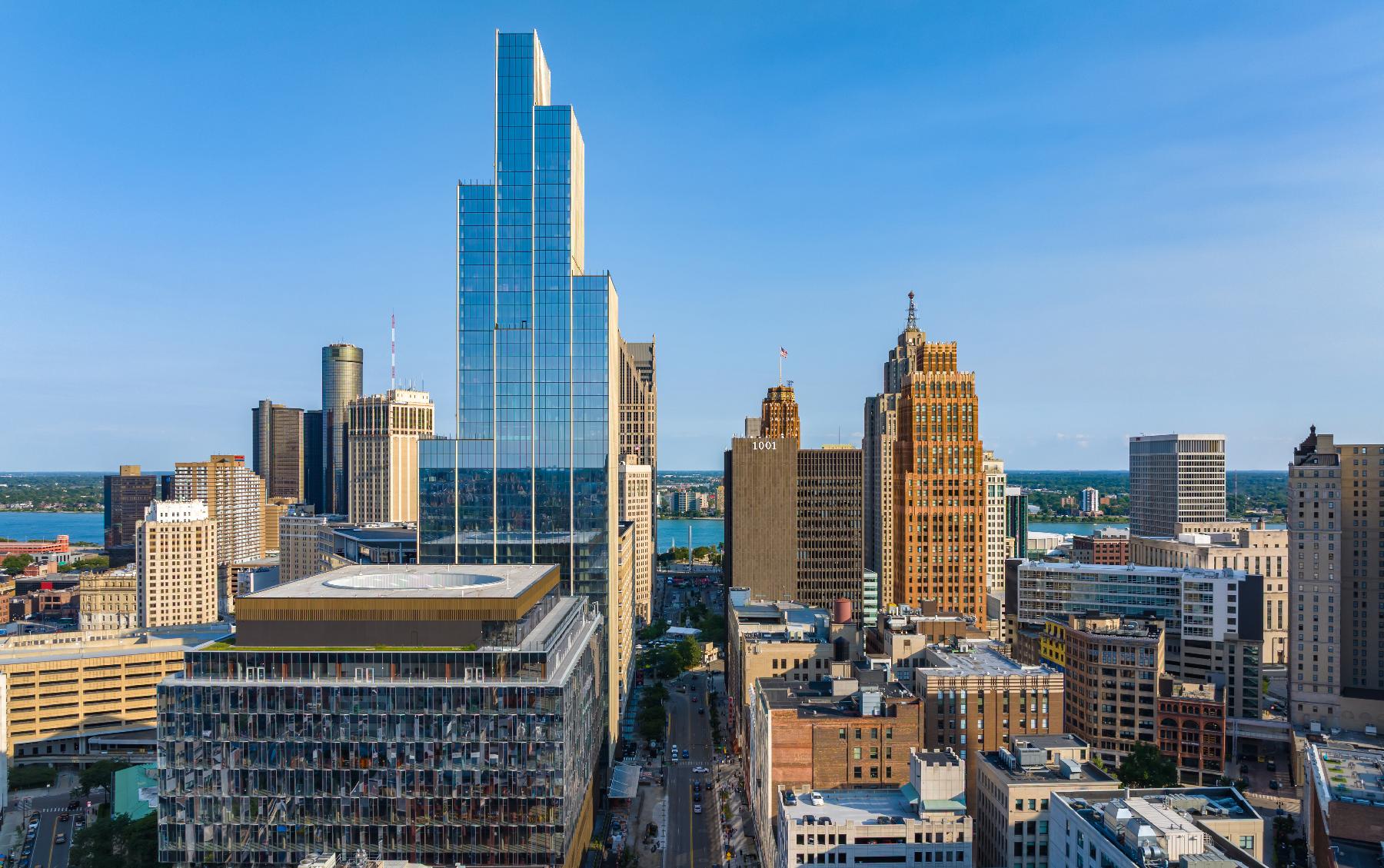
So it’s only natural that the long-lamented landmark’s reincarnation is being met with widespread enthusiasm. Designed by New York firm SHoP Architects and developed by Bedrock, the new Hudson’s is a 130,000-square-metre mixed-use complex with a 49-storey hotel and apartment tower and a 12-storey block containing offices, retail, and a large event space.
Though the curtain glass of the new tower bears little resemblance to its namesake, SHoP has included several elements that make reference to the visual flair of old Detroit, including terracotta cladding on the complex’s lower floors and a skylight inspired by the headlights of a 1954 Corvette.
Landscape may not be the first thing that comes to mind in a place as flat as Detroit – and yet the city’s extraordinary history of rapid growth followed by equally swift abandonment has given it a uniquely spacious urban form. It’s this odd hybrid of rural and urban that defines many of the new projects taking place in Detroit’s neighbourhoods.
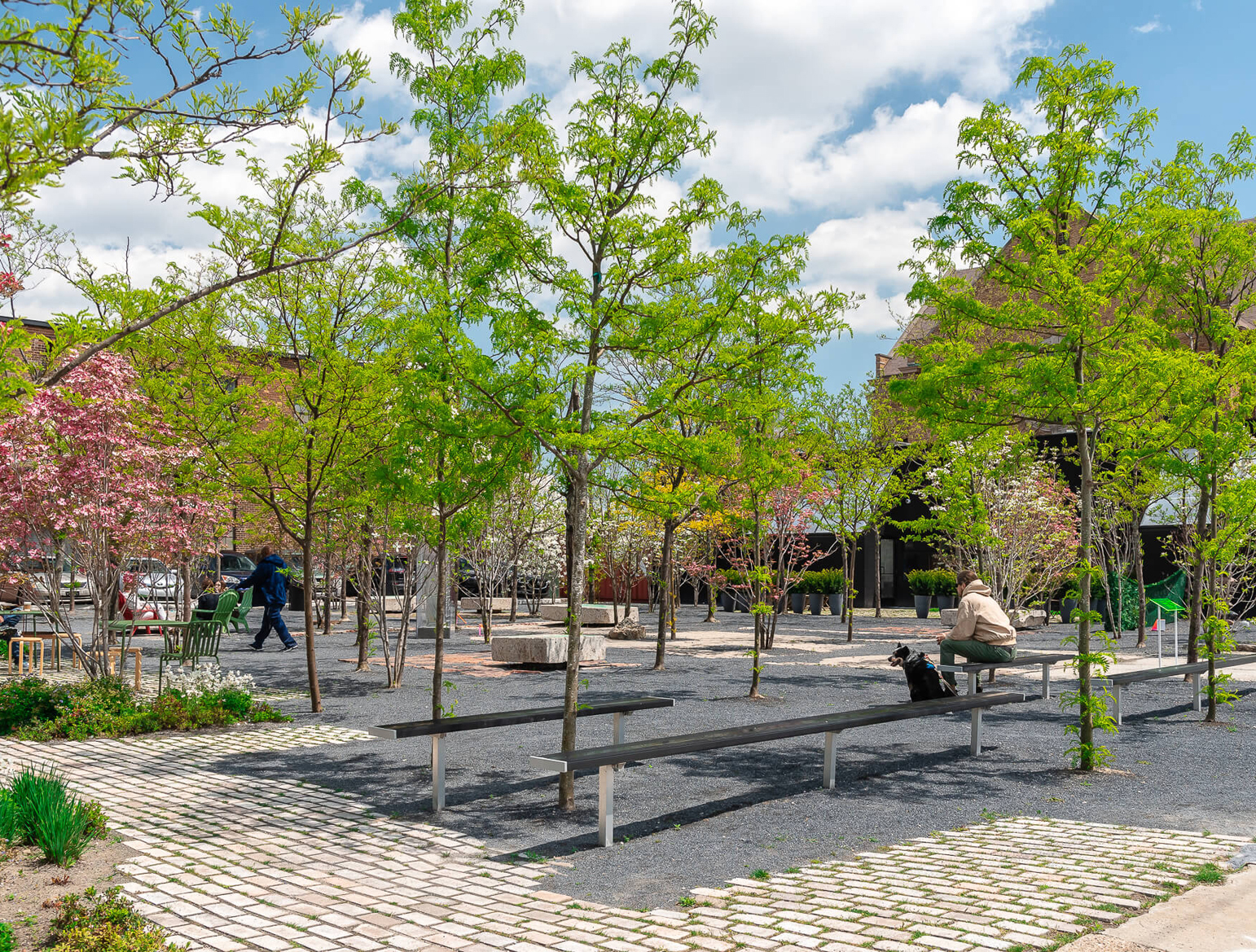
Core City is a notable example. Designed by Virginia-based landscape firm D.I.R.T. and Detroit-based architect Ishtiaq Rafiuddin, the 2019 project took a derelict corner of low-rise industrial buildings and refashioned it into a kind of urban forest dotted by restaurants, studios and galleries. Building materials excavated from the site, including the cornerstone of an 1893 firehall that had been demolished, were re-used as paving stones and decorative elements.
The project expanded developer Philip Kafka’s previous efforts in the area, including two residential complexes consisting of prefab Quonset huts.