Interview
John Treharne
The CEO of The Gym Group speaks to Kate Cracknell about growth plans and annual results strong enough to uphold the City’s new-found faith in fitness



The story of The Gym Group, one of the UK’s original low-cost private sector gym chains, has been one of strong steady growth from the outset. But it’s clear, speaking to CEO and founder John Treharne, that growth for growth’s sake has never been on the agenda.
“Since our IPO in November 2015, we’ve guided the City towards a plan of opening 15–20 gyms a year,” he says. “In 2017 we actually opened 21, in addition to the 18 Lifestyle Fitness Clubs we acquired, but we very much focus on the quality of growth and quality of returns. We could easily do more – we’ve previously opened three gyms in a week and have a structure that’s able to support faster development – but if we can only find 15 good sites in a year, we’ll only do 15 gyms.”
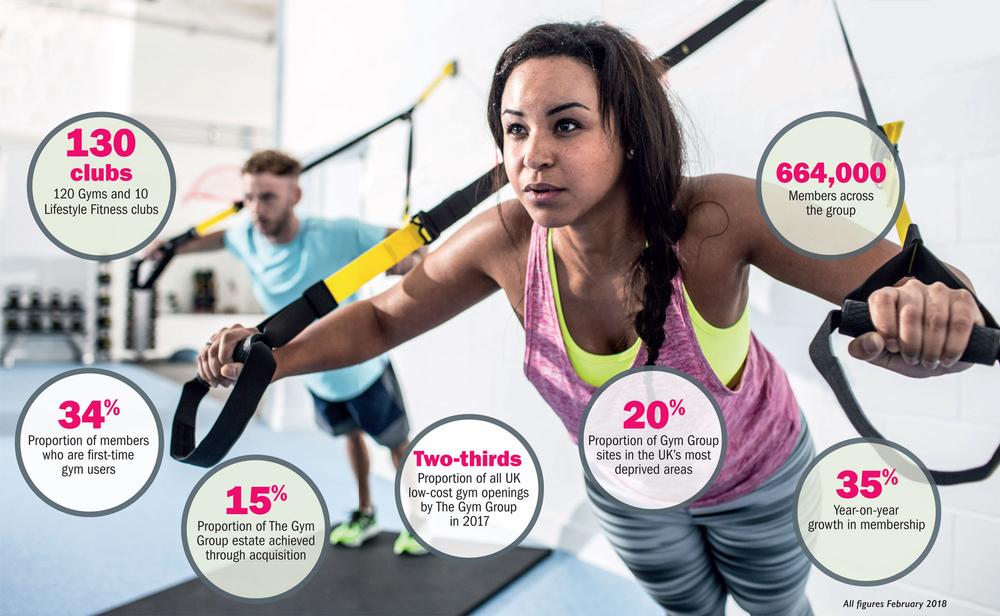
The ethos of the company – to make fitness affordable and accessible – has also strongly influenced the selection of sites, as Treharne explains: “Bridges Ventures [the Gym Group’s original investor] is a social fund, and one of its stipulations was that at least 50 per cent of our sites had to meet its social deprivation rating. In fact, over 80 per cent of our sites meet those criteria, and around 20 per cent are in the UK’s most deprived areas.
“We’re providing a gym offer that’s very much community-based, that’s affordable to all, and we also employ local people to operate the facilities.”
And it’s proven to be a strong model, with clubs that have been open for two or more years delivering a return on investment of 32 per cent across the UK estate.
“That’s part of what’s giving the City confidence,” adds Treharne. “It was very wary of the fitness sector after the uncontrolled growth of the 90s, when the eight or nine listed businesses ultimately came off the market.
“However, our consistently good results and rising share price – as well as Planet Fitness’ very strong performance on the New York Stock Exchange, and BasicFit doing similarly well in Amsterdam – mean the sector is finally getting a better reputation within the global investor community, albeit these three businesses are all low-cost operators.”
A growth sector
One interesting figure revealed recently has been the 34 per cent year-on-year growth in Gym Group membership numbers (February 2018). To what does Treharne attribute this, besides growth in club numbers?
“It’s a number of things. As the upcoming TLDC State of the UK Fitness Industry report will show, the percentage of the population using a gym regularly continues to rise and within that, low-cost gyms are faring particularly well. At Hounslow – our oldest gym – 41 per cent of the people who joined last year told us they’d never been in a gym in their life before. Price continues to be a key factor in this regard.
“We’re also seeing a significant rise in the number of members aged between 16 and 20: in some of our gyms, nearly a third of members are students. There’s a growing demand generally for healthy living, diet and exercise, but it’s especially strong among this generation.”
Constant evolution
But there have been notable changes to The Gym’s offering too, and these have contributed to the impressive membership figures. “In 2008 we were a disruptor, but if we weren’t still constantly changing and evolving, we wouldn’t continue to drive the return we’re driving,” confirms Treharne, “We’ve kept evolving.”
“It’s inevitable that what people want is now slightly different from what they wanted when we opened our first club in 2008. Similarly, I’d be horrified if our product in 10 years’ time was the same as it is today.”
He continues: “We scientifically test what our members want and need using GYMetrix, and what we see is that, while treadmills are still the most popular piece of equipment, they’re not as popular as they were. The same is true of cross-trainers. So we’re slightly reducing our provision of CV and increasing things like functional training.
“We’ve also embarked on a rebrand that will be completed by the end of 2018, not only reviewing the balance of equipment but also taking a fresh look at design. We’ve introduced better lighting and fresh colours, moving away from what – frankly – was a bit cold and white, to make it friendlier and more enticing.
“We’ve introduced zoned areas and added an element of humour to the signage around the gym, and we’re doing more live and virtual classes: in some of our bigger gyms – such as Leeds, Birmingham and Southampton – there’s a designated studio, but even our smaller gyms are now offering members 50 classes a week in an open area. That works really well actually, because it creates a positive atmosphere on the gym floor.
“So really we’ve just moved the product on and members clearly like it: on average, after we’ve rebranded and improved any club, we see an immediate uplift in membership numbers in the region of 10 per cent.
“Customer satisfaction scores also back this up. Our NPS is 62 per cent and our SMG score – which encompasses NPS but also looks at everything from cleaning to maintenance, music to safety – is currently 48 out of 60. Our bonus scheme is linked directly to SMG too, so staff are incentivised to ensure members are happy.”
Giving members choice
Another change is a premium package, priced at £4.99 a month on top of normal membership, which gives entry to all Gym Group clubs, four guest passes a month, and complimentary use of fitness testing device FitQuest to monitor progress. Following a successful trial in Q4 2017, this option is now being rolled out to all clubs.
In addition to the incremental revenue this generates for the business, it also provides new leads, as Treharne explains: “We’ve found in the past that 34 per cent of people who use our gyms on a casual basis end up joining. My guess is that a proportion of those using guest passes will do the same.”
He continues: “We see ourselves adding to the premium package over time – just as easyJet did, starting out with speedy boarding before expanding its ancillary spend into whole new areas – but I don’t think we’ll ever include anything like priority booking of classes. We want all members to be able to access everything we offer.”
Boosting service standards
Treharne says: “We believe our focus on people is one of our biggest differentiators. We’re still the only operator in the sector with a Gold Investors in People award, we’ve just been given an Excellent rating on the Best Companies to Work For list, and we got a clean bill of health in the recent HMRC report into the minimum wage. We pride ourselves on looking after our people.
“In addition, one of the benefits of our IPO is that people who work for The Gym Group now have the chance to be shareholders: they’re entitled to buy two shares for the price of one. There’s obviously a limit to how many they can buy, but it’s driving incredibly high retention rates among staff, because people feel ownership of the business which they work for.”
Embedding an ethos of staff care is clearly something Treharne feels passionate about, which makes it even more surprising that it was The Gym Group that was recently singled out by MP Frank Field for criticism over its workforce model and the status of employees.
The challenge came towards the end of 2017 and related to the company’s self-employed personal trainer contracts – a model that’s used around the world and that, according to Treharne, had never been queried by the personal trainers themselves.
He adds: “Interestingly, though, around the middle of last year – well before Mr Field raised his issues – we’d already decided we wanted to change our PT model from the one we’d used since 2008.
“That model previously saw us employ a manager and an assistant manager, complemented by a team of around 12 PTs who kept 100 per cent of their revenue in exchange for delivering 10 hours’ cover on the gym floor each week as a contribution to the business.
“It’s a commonly used model among fitness operators, but we’d realised it wasn’t giving us enough control over the service members were receiving. And that’s because, if PTs are self-employed, we can’t send them on training courses to enhance their skill sets and service standards.
“We’re now offering our personal trainers three different employment choices. Option number one, if they don’t want to do any hours on the gym floor, they just pay us rent and keep 100 per cent of their revenues.
“The second option is where we’ll make the biggest difference, because it will apply to the majority of PTs. In this scenario, they give us 10–12 hours a week and we pay them for those hours, but they’re then employed. They get all of the entitlements – maternity pay, holiday pay and everything else the employee is entitled to – but if we want them to attend training, they have to attend during the hours they’re employed by us: the 10–12 hours a week. Then the rest of the time they’re a freelance personal trainer, paying a lower rent than in option 1, and get to keep 100 per cent of their income.
“The third and final scenario will see us simply pay people. That will apply mostly to freelance instructors in specialist disciplines such as Pilates in which our personal trainers, who run most of our classes, aren’t qualified.
“We see the net effect as being cost neutral: it won’t cost any more, but it will give us more control and will mean our members get a better service, because we’ll be able to train everybody who works with us better.
“It will also improve people’s career opportunities with us. Already around 40 per cent of our management recruitment is done internally, but this new commitment to training is likely to boost that still further.
“While we didn’t do any of this because of Mr Field, clearly many of his concerns have been allayed, as he now understands our position more clearly. His most recent correspondence with us has been significantly friendlier.”
Frank Field aside, what are Treharne’s views on the government’s contribution to the physical activity agenda – does he feel important steps are being taken to recognise the value of the fitness sector to society?
“Government is still not paying enough attention,” he says firmly. “It might have taken a few small steps in the right direction, but it could be doing a lot more.
“This is a real bugbear for me,” he continues, “If exercise is important in terms of taking pressure off the NHS, why don’t we reduce the VAT on it? It wouldn’t cost the government much, but price is such a big driver in fitness that it would result in more people exercising. That has to be in the government’s interests. It happens in Spain, it happens in the Netherlands, it happens all over the world, but never in the UK – not unless you’re a trust. It should be universally applicable.
“And why isn’t gym membership a tax-allowable benefit? Very few companies in the UK provide membership to employees, because the staff member then has to pay tax on that benefit. That doesn’t happen in America, or in most of Europe, because gym membership is seen as beneficial to the workplace and to society. We need to review the situation in the UK.”
Looking forward, The Gym Group is clearly in a strong position, accounting for two-thirds of low-cost openings in the UK in 2017 and with a solid plan for growth.
Treharne explains: “Most of the research on the sector suggests there’s demand for over 1,000 low-cost gyms in the UK. At the end of December 2017 there were 572, so there’s plenty of potential, particularly as the market is also growing. I’d be amazed if we didn’t have at least 250 gyms in the UK in five years’ time. They’ll come predominantly through organic growth, funded from our cashflow and based on 15–20 openings a year.
Using ex-retail space
“In terms of space, we’re flexible. We convert nightclubs and offices – we’ve done a casino but at the moment we’re taking on a lot of ex-retail space. We’ve done five sites with Sainsbury’s where we took 15,000sq ft. We have separate entrances, but benefit from each other’s footfall and there’s free car parking. It’s a good arrangement. We’re doing similar with a growing number of other retailers: one recent opening was in a BHS, and the closure of Toys R Us will throw up opportunities.”
He continues: “We’d still like to go into Europe, but Brexit has thrown a spanner in that particular works: it would be unwise to make a move until there’s more certainty over what it will mean, so for now, our focus is firmly on quality growth within the UK.”
2017 year-end figures
£91.4m Revenue (+24.3%)
£28m Group adjusted EBITDA (+23.2%)
£12m Adjusted profit before tax (+37.9%)
32% Return on capital from mature estate
21 New Gym Group sites opened
18 Lifestyle Fitness Clubs acquired
607,000 Members at 31 December 2017 (+35%)
Brief history of The Gym Group
2008 First site opens in Hounslow
2008 Financial backing secured from Bridges Ventures
2009 Sites 2 and 3 open in Guildford and Vauxhall
2009 Roll-out gathers pace, with Bridges’ backing and debt provision from HSBC
2013 Bridges partially exits; Phoenix becomes major shareholder (£50m investment)
2014 Gym Group/Pure Gym merger is scrapped following CMA referral to phase 2 investigation
2015 The Gym Group floats on the London Stock Exchange
2017 The Gym Group reaches 100 clubs and 500k members
The Gym Group launches personal training academy

The Gym Group has revealed plans to launch its own PT academy.
Working in partnership with Lifetime Training, The Gym Personal Training Academy will offer career pathways for people seeking a career as a personal trainer.
The first academy sites have launched in London, Manchester and Birmingham, with more locations to be added later in 2018.
Participants will receive a Level 3 Diploma, a guaranteed interview with The Gym Group, end-to-end support from training to self-employment, and a year’s free gym membership.
The one-year course costs £2,849 and the company expects to attract 350 candidates a year.
Jacqueline Regan, people director at The Gym Group, said: “Our aim is that the academy will not only support personal trainers to operate their own business, but also provide the consistency of personal training our members tell us they’re looking for.
“We’ll also offer participants some fantastic personal development through our 12-month CPD offering, which is underpinned by four key themes: building a better business, nutrition, strength and conditioning and training for the general population.
Lifetime’s Sean Cosgrove said: “Partnerships such as this are the perfect way to combine the expertise of a training provider with the experience of an operator.”
"Our new personal training academy will not only support PTs to operate their own business, but also provide the consistency of personal training members tell us they’re looking for" - Jacqueline Regan, people director, The Gym Group
Treharne on VAT and tax breaks

“If exercise is important in terms of taking pressure off the NHS, why don’t we reduce the VAT on it? It wouldn’t cost the government much money, but price is such a big driver in fitness that it would inevitably result in more people exercising. That has to be in the government’s interests. It happens in Spain, it happens in The Netherlands, it happens all over the world, but it has never happened in the UK – not unless you’re a trust. It should be universally applicable.”



















Designed to restore neglected land and renew the identity of Iraq’s capital city, Baghdad Sustainable Forests promises a new way of living surrounded by nature. Gensler’s Ian Mulcahay tells us why he thinks the project could become a model for the repair and enhancement of urban centres