Tech
Digital futures
Whether you’re a digital experimenter or a digital leader, 2023 will be a pivotal year in the sector’s tech transformation journey say David Gerrish and Jon Reay




The presence of digital services in fitness and leisure may seem a given in today’s market, as consumer demands and expectations accelerate in all areas of life. But as health club and leisure operators continue to evolve and develop their services it’s inevitable that they find themselves at different stages of the journey.
UK Active and Sport England have published the second edition of the Digital Futures report to support operators in accelerating their digital strategies. It provides an update on the digital maturity and effectiveness of the sector, with operators using UK Active’s free Digital Maturity and Effectiveness Index Tool to get their score and advice about next steps.
The findings are based on consultation with 93 public and private sector operators, representing more than 1,800 sites across the UK and serving an estimated 4.5 million consumers nationwide. Using more than 6,700 data points, analysts from consultancy Rewrite Digital were able to provide a year-on-year measure of progress for the sector, while also benchmarking it against other sectors.
The publication was supported by UK Active and its strategic partners, E Gym, Gladstone, Les Mills, Myzone, Technogym and Xplor, and forms part of UK Active’s Digital Futures strategy, in partnership with Sport England.
The report provides a series of strategic and practical recommendations for operators of all sizes to improve their approach. These include advice on developing a digital strategy, personalisation, gaining consumer insights, delivering customer experiences, and digital inclusion.
Here, we answer some of the burning questions for the future of digital in the sector.
What does the latest Digital Futures report tell us about the sector’s digital maturity?
The overall score for the sector this year is 51 per cent, placing it in the ‘Digital Experimenter’ percentile. This means operators are making advances in digital but needs ongoing investment to keep pace with – and respond to – consumer demands.
The average score doesn’t tell the full story, however, as the sample was very diverse, with three ‘Digital Leaders’ scoring 80 per cent or more, versus nearly a quarter (24 per cent) of operators scoring less than 40, showing a huge gap between those who are harnessing digital and those who are falling behind.
The sector’s overall appreciation of the value digital can have in enriching consumer experiences is growing ever stronger, with 46 per cent saying they’re actively and/or heavily investing in digital compared to 34 per cent in 2021. Digital Future’s role is to elevate the whole sector, so there’s work to do here.
Why has there been a drop in the sector’s overall digital maturity score?
Last year, the score was four percentage points higher at 55 per cent, but this doesn’t necessarily mean digital is less of a priority.
There are a number of possible reasons for this drop. The course of the pandemic will have impacted results, with the reopening of physical facilities reducing some of the dependency on digital services, while the cost of living crisis has forced businesses to review their own expenses and focus their resources in ‘essential’ areas, which has slowed innovation for some operators.
We also saw higher participation among smaller operators this year and they tend to score lower.
In some cases the greater the knowledge and understanding of digital, the more accurate and realistic – and sometimes lower – the score.
What are the key trends you’re seeing following your consultations in 2021 and 2022?
Top-scoring operators surpassed 2021’s highs in 2022 and the increase in participation from operators demonstrates the greater importance of digital for the sector as a whole.
This year we’ve also seen increased investment in digital and in digital skills and mindsets, as well as the first operators using machine learning in business process automation.
Overall, however, a smaller percentage of operators have a digital strategy than we saw reported in 2021 and systems are still holding operators back.
In response to new questions for this year’s consultation and report, half of operators say they know about the needs and expectations of their customers, but just 15 per cent say the same about their target non-customers. There’s a greater appreciation of the value front-end-facing consumer experiences have when it comes to enriching membership value. There’s also low awareness and adoption of open data.
Which parts of the sector are performing best and what can others learn from this?
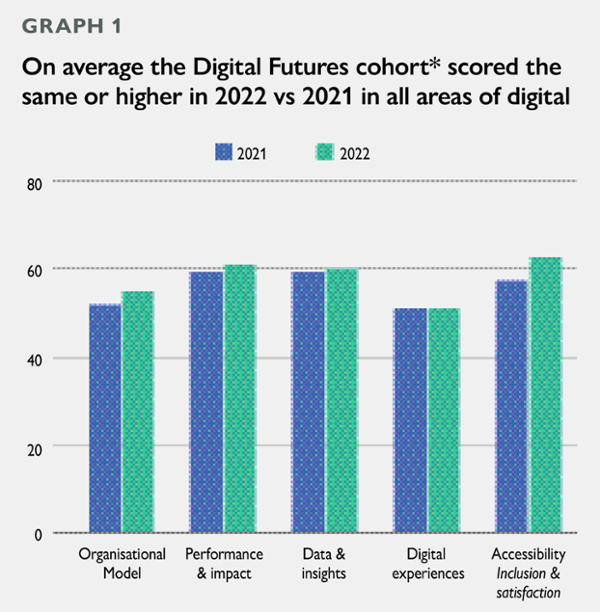
The ‘Digital Futures’ cohort of operators – what we call the operators who participated in both the 2021 and 2022 Digital Futures consultation – have performed better on average this year compared to last year and compared to the sector overall.
As with last year, private operators score higher than public operators for all areas of digital, with university operators scoring lower still. The size of the operators surveyed also heavily influences their digital score, with larger operators scoring significantly higher in all areas of digital.
Operators can’t change their size or public/private status but they can all benefit by engaging with the Digital Futures programme and taking advantage of its free Digital Maturity and Effectiveness Index Tool to help inform improvements in their digital strategy.
How does the health and fitness and leisure sector compare to other sectors?
We’re not alone in facing these challenges, but we can also learn from other, arguably more advanced, consumer-facing sectors such as retail, entertainment, and financial services, when it come to how they’re using digital.
In comparison with other sectors, digital skills adoption in fitness and leisure surpasses that of small businesses in other sectors, while operators’ perceived stage of digital maturity and level of progression beats charities and other non-profit organisations. We’ll continue to benchmark against other sectors in future years to see how we make gains on sectors that are more digitally mature.
What are the incentives for organisations to improve their digital effectiveness today?
Digital effectiveness is tied to business outcomes such as revenue, member acquisition and retention and cost efficiencies, as well as societal value, so there’s a clear incentive for giving it attention and investment.
Operators that have participated in Digital Futures have seen growth in their digital maturity and effectiveness. There’s no cost for operators when it comes to checking their score using the Digital Maturity and Effectiveness Index Tool, to see where improvements can be made and access resources to help grow their score.
To use this tool, go to www.hcmmag.com/digitalscore.
What are the implications for inclusion and reaching a wider audience?
The digital divide is an unintended consequence of progress and the development of digital transformation and modern life online.
We need to be mindful when a product, service, or customer engagement touchpoint becomes digital-only as we run the risk of excluding consumers who lack basic digital skills, don’t have access to devices or an internet connection, or disabled consumers who may need accessibility features and tools to support them.
While operators claimed they’re more inviting to those consumers who are new to the sector when compared with last year, fewer operators said that they’re providing alternative means of engagement to digital, risking higher rates of digital exclusion among user groups without access.
What’s the next step for Digital Futures?
This is a programme for the sector, by the sector, so we encourage operators and suppliers to reach out and tell us what they think will benefit their organisations.
The Digital Futures 2022 report provides 12 important recommendations for how health and fitness operators can enhance their digital effectiveness. As with the 2021 report, two consistent themes have emerged: firstly, the need for greater collaboration to share best practice and case studies to support investment and secondly, simplification to allow operators to maximise their investment, support existing members and increase participation.
Additionally, UK Active has been asked to provide further digital knowledge upskilling and – within a crowded marketplace – some form of evaluation of the effectiveness of digital interventions.
UK Active, alongside Europe Active, will continue to offer operators practical support in growing their digital maturity and effectiveness and next year we will once again conduct an operator consultation to build on 2022’s benchmark.
2023 will be a pivotal year for the strategy, as UK Active widens its reach to incorporate all ecosystem partners that connect to the delivery of leisure, fitness and community programmes. In order to influence all touchpoints of the physical activity ecosystem, we will broaden engagement to the national governing bodies for sport in the UK, the Active Partnership Network, and a wider representation of industry suppliers. We’ll also be benchmarking with operators in territories outside the UK to learn from global leaders.
With that in mind, the Digital Futures team asks all operators that have yet to participate in the review of their digital maturity and effectiveness to do so as soon as possible.
We look forward to continuing to build the digital maturity of the sector in 2023 and beyond.
• David Gerrish is strategic lead for digital at UK Active, and Jon Reay is CEO and founder at Rewrite Digital
To read the Digital Futures 2022 report visit: www.ukactive.com/reports/digital-futures-2022