Retention
Pain response
Are you optimising HIIT for your members, or are they put off by the pain? Abigail Harris looks at research into ways to better support members towards a positive outcome



More than 40 years ago, way before HIIT became an ‘in’ word, exercise physiology expert, Michael L Pollock’s 1978 research claimed ‘high intensity exercise causes more injuries and drop outs than continual training’. In fact, he stated: “High intensity exercise appears to be neither enjoyable nor well tolerated by non-athletes who are training for general health and wellness.”
It’s a truth backed by retention specialist Dr Paul Bedford, who says the harder you work some members, the quicker they’ll leave. So unless they’re managed carefully, HIIT classes and workouts could have a negative impact on retention; particularly with new members.
Masking the pain
Bedford discovered an issue with HIIT classes and retention while carrying out gym floor surveys for a multi site operator.
Members who’d been exercising for some time were keen to step up and try HIIT, but new exercisers, who thought it looked fun, discovered the discomfort they experienced was so great, some only did it once.
“Pain is the body’s way of telling you something’s wrong, and many people new to exercise don’t recognise the difference between pain and discomfort, so may believe it’s not how their body should feel. They need to get used to the discomfort it brings,” he says.
Interviewing people afterwards, Bedford found there were two ends of the spectrum – those who enjoyed being challenged at one end and at the other, those who found the discomfort so great it put them off forever.
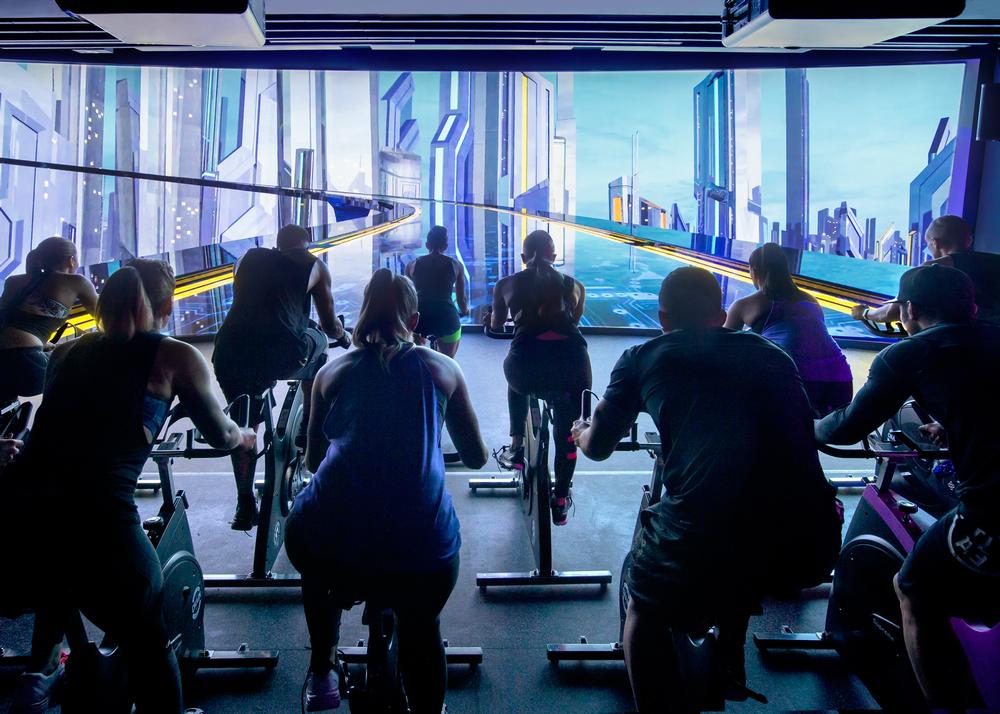
Group fitness specialist, Les Mills International (LMI), took all of this into consideration when developing its immersive indoor cycling programme, The Trip, by using technology to make the workout seem easier.
LMI’s head of research, Bryce Hastings explains: “We conducted a study on perceived exertion during The Trip that demonstrates that visual stimulus can lessen the discomfort of exercise, while still maintaining high levels of intensity. Novice exercisers were so absorbed while working out, they barely noticed how hard they’d exercised.”
The research, carried out by Penn State University associate professor Jinger Gottschall, involved both elite and novice fitness participants completing eight audio-only, group fitness cycling classes and eight immersive classes (music and digital images), over an eight week period to study their exercise intensity and perceived exertion.
The results showed the novice group’s rate of perceived exertion (RPE) – or how intensely they thought they had worked out – was less when doing The Trip than when doing the audio-only class, despite their heart rate intensity being the same.
“It’s ideal for relative newcomers as they’re getting into a higher heart rate zone without feeling the discomfort of this intensity level,” says Hastings. “The novice participants also rated their enjoyment and satisfaction higher than the audio-only class, which has a positive bearing on them keeping up with regular exercise.”
Creating an experience
The overall perception of a class also holds valuable clues when it comes to members’ responses.
Jeremy McCarthy, group director of spa and wellness at the Mandarin Oriental Hotel Group has developed a theory around ‘last impressions’, their impact on behaviour and how likely people are to repeat experiences. He says: “Many businesses spend a lot of time thinking about the first impression, but research shows the last impression is actually more important.
Daniel Kahneman coined the phrase ‘the peak-end rule’ to describe the fact people’s memory of past experiences is driven by the peak moments of that experience and how the experience ends.”
In McCarthy’s book, The Psychology of Spas & Wellbeing, he references research by Kahneman showing that people’s memory of the discomfort of a colonoscopy is driven by the peak moments of discomfort and how the treatment ends, without regard for the overall duration or total amount of discomfort they experience. These findings have influenced the way he thinks about delivering experiences.
He says: “Based on this, we ensure our treatments end in a pleasant way by avoiding a negative or abrupt ending. They finish with a soft chime and we bring tea to our guests without rushing them straight off the table or out of the treatment room.
“Giving gym members something that’s challenging but achievable towards the end of a HIIT workout could help in this way too,” says McCarthy, “‘Flow’ experiences happen when we are challenged but able to rise to meet the challenge. Towards the end of a workout people may be feeling fatigued and frustrated. Giving them a chance to feel strong and achieve flow could send them out with positive memories of the experience.”
Bedford agrees, saying: “Lasting impressions are so important. If the member comes out of the class feeling like they’ve worked hard but they’re not in pain, they’re more likely to do it again. Instructors should consider backing off the intensity a little with new members, and be slightly preventative to reduce the pain they’ll experience afterwards. Give them a really good cool down so they don’t hurt so much in the following days too.
“At the end of the class get everyone to congratulate each other. Gather them together, high five them and reflect on what they’ve done. Talk about their effort, the intensity and their skill development; three things that help motivate people to exercise. They will feel more successful and are more like to return.”
David Barton experience
US-based gym owner and designer David Barton also embraces this philosophy in the overall experience his health clubs offer, but with a different twist. He explains: “Ultimately we’re selling something people don’t like. There are lots of ways to get them in on day one, but how do we make them want to come back tomorrow, when they like the outcome, but not the process?”
According to Barton, the gym’s design is just part of a larger experience. “We have to find a pathway into someone’s imagination. People appreciate beautiful things and like to be in a beautiful environment. It’s not just visual, but what they smell, touch and hear too. All senses will be working to compete with their pain receptors because they are in an unfamiliar environment, so we use design, lighting, technology and exercise science to create the ultimate setting and an emotional experience. My goal is to create the impression that they’ve entered into another world, a world so enticing it competes with the potential negative; the process of exercise itself.”
Barton admits gym design may not have altered the results of Bedford’s study, citing HIIT itself as the challenge, as it triggers the fight or flight survival response, but, he says: “The environment has a massive effective on the imagination and can provide an experience so positive that it literally overwhelms the negativity of a hard workout.”
Bedford points out that it’s also important to remember HIIT is all relative to the individual: “For some people, HIIT may just be walking briskly, while to another it might be jumping in and out of a giant tyre. We observed there was very little adaptation to exercises based on fitness level; instructors expected everyone to kill themselves doing burpees, without considering their experience.
“Whilst there’s some naivety around new exerciser thinking they can do it, responsibility must also be taken by the instructor. We also witnessed insignificant warm ups and cool downs; people didn’t have time to adjust – it was literally a 30 minute workout with an, ‘I’m going to kill you’ approach.”
Hastings agrees and says LMI’s research, in collaboration with Professor Gottschall, found that any more than 45 minutes working out at above 90 per cent of the maximum heart rate per week doesn’t help achieve transformative effects anyway. “In fact, too much actually hinders,” he says. “Pushing the body into its maximum training zone for short periods triggers a positive stress response, creating bio-chemical changes in the body that help build new muscle and improve fitness. Those doing more were unable to produce a positive stress response, so our recommendation is to balance weekly HIIT sessions with other, less intense cardiovascular and strength workouts.”
One thing’s for sure, high intensity training is here to stay, and Bedford’s advice is to offer newbies exercise alternatives or to grade classes so people can build up the intensity over time.
























Designed to restore neglected land and renew the identity of Iraq’s capital city, Baghdad Sustainable Forests promises a new way of living surrounded by nature. Gensler’s Ian Mulcahay tells us why he thinks the project could become a model for the repair and enhancement of urban centres